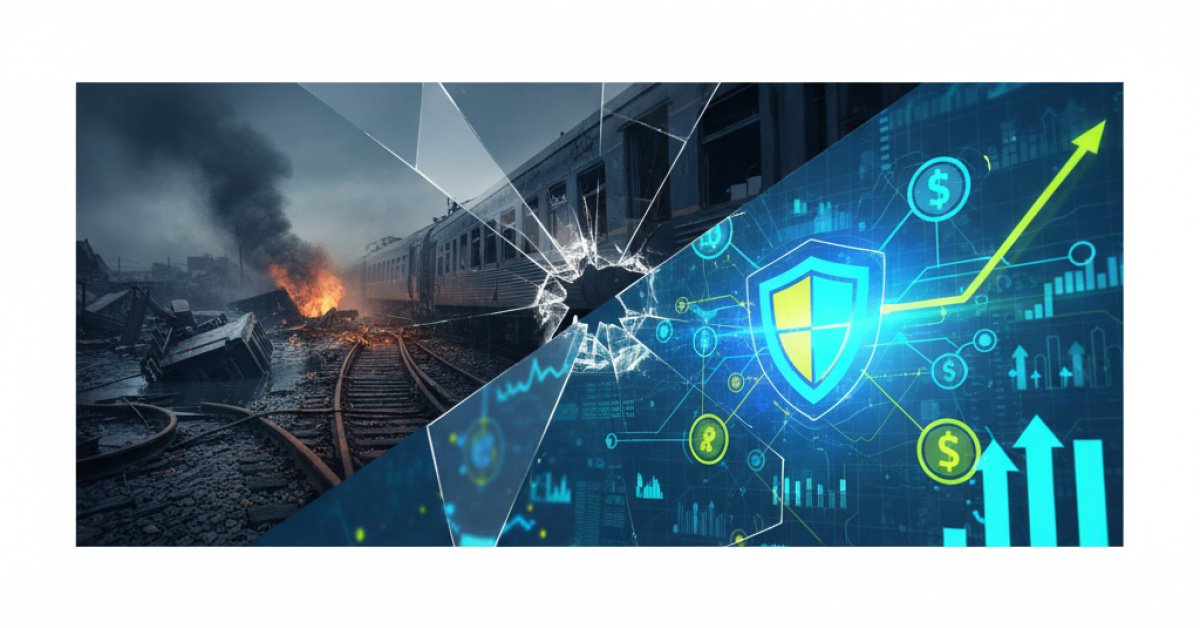
When I first saw the headlines about the passenger train derailment in Mexico, my heart sank. Thirteen people lost their lives, and nearly a hundred more were injured. It’s a terrible human tragedy, first and foremost.
But as someone who spends their days in the world of insurance, my mind immediately goes to a second, parallel story. It’s the story of risk, liability, and the massive, incredibly complex financial safety nets that are supposed to catch a project when something goes this wrong.
Because behind every gleaming new railway, every towering skyscraper, and every ambitious "megaproject," there’s a mountain of insurance paperwork. And when a disaster like this strikes, it sends shockwaves through the entire industry. It’s a brutal, real-world stress test of the policies designed to cover the unthinkable.
So, Who's on the Hook When a Megaproject Fails?
You might think of it like your car insurance, but on a scale that’s almost hard to wrap your head around. When a multi-billion-dollar project is underway, it’s not just one policy. It’s a layered, intricate web of coverage put together by a syndicate of insurers, because the potential losses are too huge for any single company to handle.
Let's break down what's likely in play here:
- Property & Construction Coverage: This is the most obvious one. It covers the physical damage to the train itself, the tracks, and any other infrastructure that was destroyed. This is a massive bill, but in the grand scheme of things, it’s often the most straightforward part of the claim.
- Public Liability Insurance: This is the big one. This is where the human cost gets translated into financial terms. With 13 fatalities and 98 injuries, the liability claims will be immense. We're talking about covering medical costs, long-term care, loss of income, and wrongful death settlements. These claims can take years to resolve and can easily run into the hundreds of millions of dollars.
- Delay in Start-Up (DSU) Insurance: This is a fascinating piece of the puzzle. These megaprojects are often tied to huge economic forecasts. A tourist railway, for example, is expected to start generating revenue by a certain date. When a major accident shuts it down, that’s millions in lost income. DSU insurance is designed to cover the project's owner for that lost revenue while repairs are made. It's basically business interruption insurance for a project that hasn't even started yet.
When you see a headline about a derailment, you see a tragic event. An insurer sees all of these policies triggering at once, creating a "clash event" that can become one of the most complex and costly claims imaginable.
For Underwriters, One Accident Is a Data Point. A Pattern Is an Alarm Bell.
Here’s the thing that really makes the insurance world nervous: this wasn't a complete bolt from the blue. The reports mention this is just the latest in a series of accidents that have plagued Mexico's recent infrastructure projects.
For an underwriter—the person whose job it is to calculate risk and set premiums—a pattern is the ultimate red flag.
Think of it like this: if a teenage driver gets into a fender bender, their insurance rates will go up. But if they get into three accidents and get two speeding tickets in six months? The insurance company might just decide they’re too risky to insure at any price.
It’s the same principle here, just with more zeroes. When underwriters see a pattern of safety issues, they start asking tough questions:
- Are corners being cut to meet deadlines?
- Is there a systemic issue with training or maintenance?
- Is the safety culture on these projects what it should be?
This directly impacts the project's insurability. Premiums skyrocket. Insurers will demand incredibly strict conditions, known as warranties, be written into the policy—things like mandatory third-party safety audits or specific maintenance schedules. If those conditions aren't met and an accident happens, they might have grounds to deny the claim. In the most extreme cases, insurers will simply walk away, deeming the project "uninsurable."
The Political Wrinkle: Why Government Projects Are a Different Beast
The fact that this is a high-profile, government-backed project adds another layer of complexity. When President Claudia Sheinbaum is being pressured over the project's safety record, it’s not just a political issue; it’s an insurance risk factor.
Insurers call this "political risk." State-run projects can sometimes operate under different pressures than private ones. There can be intense political will to get a project finished by a certain date, perhaps to coincide with an election or a national celebration. Does that pressure lead to rushed work or overlooked safety checks?
This is something that keeps underwriters up at night. They have to factor in the stability of the government, the regulatory environment, and the potential for political interference. It complicates the claims process, too. Navigating a massive liability claim is hard enough, but doing it with a government entity on the other side of the table can be a bureaucratic nightmare.
What This Means for the Future of Insuring Big Ideas
A tragedy like this doesn't just affect this one project. It has a ripple effect across the entire market for megaproject insurance, especially in the region.
You can bet that any new, large-scale infrastructure project in Latin America is now going to face even more scrutiny from insurers and reinsurers (the companies that insure the insurance companies). They will look at this derailment as a case study in what can go wrong.
We’re likely to see a "hardening" of the market. That’s industry-speak for higher premiums, less available coverage, and tougher terms for everyone. Insurers will demand a much bigger say in risk management from day one. They won't just be the people who pay the bill; they'll insist on being active partners in preventing the disaster in the first place.
It's a stark reminder that while these projects represent progress, ambition, and national pride, they are built on a foundation of calculated risk. And when that calculation is wrong, the human and financial cost is devastating. For the people who lost loved ones, it’s an unimaginable loss. For the insurance industry, it's a painful and expensive lesson in the true price of risk.