It feels like just yesterday that seeing a solar panel on a roof was a novelty. Now, you can’t drive through a neighborhood without spotting them everywhere. Same with electric cars—once a rare sight, now they’re silently cruising down every street and plugging into chargers in every parking garage.
And that’s a good thing, right? We’re all trying to do our part for the planet. Moving away from fossil fuels and building with sustainable materials is a huge step in the right direction.
But here’s the thing we need to talk about, especially if you own or manage property: these fantastic green technologies come with a whole new set of risks. Risks that can be pretty serious if we’re not prepared for them.
I was chatting with Ed Leibrock, who heads up Corporate Property at Munich Re F&C, and he put it perfectly. He said these technologies are “wonderful for the environment, but they bring along extra property hazards with them.”
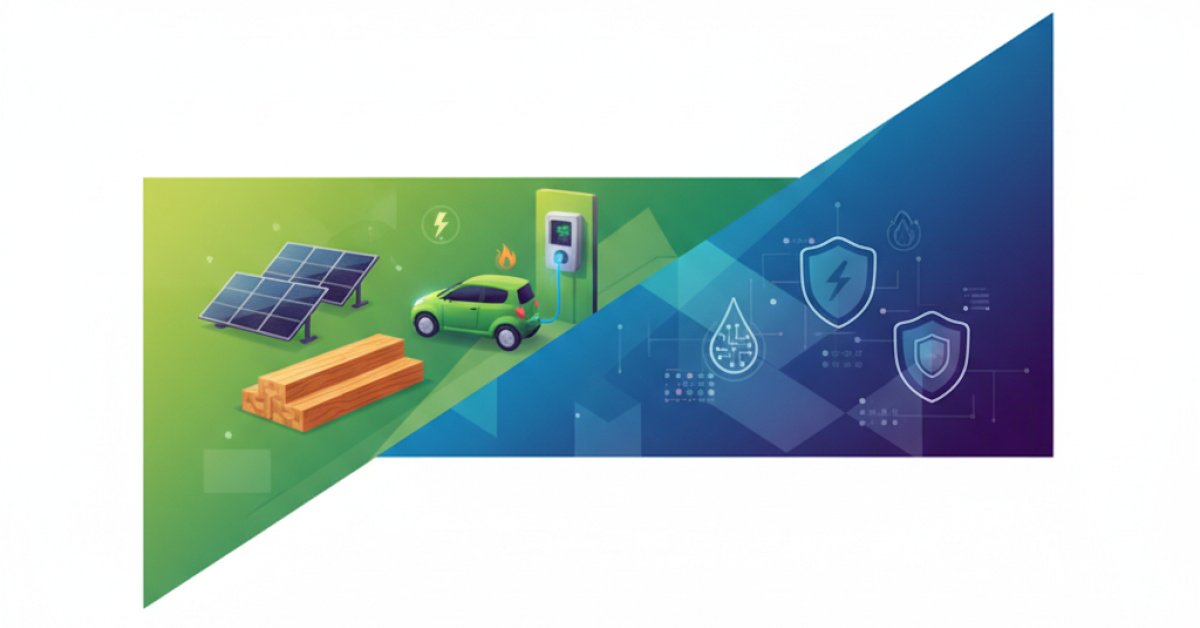
So, let’s pull back the curtain on three of the biggest game-changers—solar panels, EVs, and a cool new building material called mass timber—and get real about the risks they bring to the table.
The Sunny Side of Solar Has a Fiery Downside
We look at solar panels and see clean energy. Firefighters, on the other hand, see a major headache.
Imagine this scenario: a fire breaks out in a building with a roof covered in solar panels. The fire department arrives, but they’re immediately facing a huge challenge. As Ed explained, “many times firefighters themselves don’t want to fight the fire because solar panels are constantly energized and therefore can be hazardous.”
Think about that. There’s no “off” switch for the sun. As long as there’s daylight, those panels are live, creating a constant electrocution risk for anyone trying to put water on that roof.
But it gets even more complicated.
The small gap between the panels and the roof surface creates what’s basically a wind tunnel. If the fire reaches the roof, this gap acts like a chimney, sucking the flames sideways and spreading them across the roof at an alarming speed.
On top of that, a standard firefighting tactic is to cut a hole in the roof to ventilate the smoke and heat, allowing crews to get inside safely. You can’t exactly do that when the roof is covered in a grid of energized glass and metal.
So what happens? Often, firefighters have to switch from an offensive attack to a defensive one. They work on containing the blaze and letting the part of the roof with the panels essentially burn itself out in a controlled way. It’s a tough situation that can lead to a lot more damage than a typical fire.
And it’s not just about fire. The installation itself matters. These panels are heavy. Was the roof engineered to handle the extra weight? Are the panels secured well enough to withstand high winds? Every bolt that goes into the roof is a potential entry point for water if it’s not sealed perfectly.
That E-Bike in the Hallway? It’s a Bigger Risk Than You Think
We’ve all seen the headlines about fires from e-bikes, scooters, and even electric cars. The culprit is almost always the lithium-ion battery. These batteries pack an incredible amount of power into a small space, but when they fail, they fail spectacularly.
It’s a process called “thermal runaway,” and it’s not like a normal fire. It’s more like a mini-explosion that releases toxic gas and is incredibly difficult to extinguish. You can’t just douse it with a regular fire extinguisher.
The real problem, from a property risk standpoint, is where we put these things.
EV charging stations are usually in the best parking spots, right next to the building’s entrance. Cars are parked in garages directly underneath apartments and offices. And maybe the biggest risk of all? People are bringing their e-bikes and scooters right into their apartments to charge them overnight.
You’re essentially bringing a known, volatile fire hazard inside the building. If one of those batteries goes, you’re not just dealing with a burnt scooter; you’re looking at a potential structure fire that starts inside the living space.
Mass Timber: Beautiful, Sustainable, and a Little Tricky
If you haven’t heard of mass timber, you will soon. It’s an engineered wood product made by gluing layers of timber together to create massive, strong beams and panels. Architects love it because it’s sustainable, strong enough to build high-rises, and looks absolutely stunning. Think of those beautiful, modern buildings with exposed wood grain ceilings and beams.
But that beautiful, exposed wood creates a unique insurance puzzle.
Let’s say there’s a small fire. In a steel-frame building, you’d scrape the char off a steel beam, slap on some fire-retardant paint, and you’re done. But with mass timber, the wood grain is the finish. As Ed pointed out, “you don’t really scrape that down and paint it… that eliminates the aesthetic value to it.”
So, is that cosmetic damage covered by a standard property policy? It’s a gray area that we’re all still figuring out.
Repairing it is also a challenge. Mass timber buildings are assembled a bit like giant Lego sets. If a single beam on the third floor of a ten-story building is damaged, how do you replace it without taking the whole thing apart? It's a logistical nightmare.
And here’s the kicker: while it can be a bit cheaper to build a new building with mass timber, it’s not cheaper to repair a partially damaged one. And let’s be honest, most insurance losses are partial, not total.
Okay, So How Do We Manage These Risks?
Look, nobody is saying we should give up on green tech. We just need to be smarter about how we integrate it. It’s all about planning and mitigation.
For Solar Panels: Think Beyond the Roof
- Hire Pros: This is not the time to go with the lowest bidder. Ed stresses this: “Investing in a qualified contractor and an engineer is definitely something that every risk manager or property owner should be taking into account.”
- Choose Your Materials Wisely: Some panels have more plastic components, which adds to the fire load. Others are built with more steel and aluminum. Do your homework.
- Consider the Parking Lot: The absolute best advice? If you have the space, don’t put the panels on your building’s roof at all. Put them on canopies over your parking lot. You get the same clean energy, you provide shaded parking for employees or tenants, and you completely separate the fire risk from your main building. It’s a win-win-win.
For EVs and E-Bikes: Create Some Space
- The 100-Foot Rule: The simplest defense is distance. “We recommend 100 feet of clear space between a building and an EV charging station,” Ed says. That’s a very effective fire break.
- Build a Bunker (Sort Of): If chargers have to be inside or under a building, they need to be in a dedicated, fire-rated room. We’re talking a three-hour-rated wall and a self-closing steel door. This is becoming standard practice in big cities like New York, where buildings are creating dedicated, fire-safe rooms just for charging e-bikes and scooters.
- Have a Clear Policy: If you manage a residential or commercial building, you need a firm policy. Either you provide a safe, designated charging area, or you have a rule that strictly prohibits them from being brought inside.
For Mass Timber: Protect the Aesthetic
- Cover It Up (Where You Can): I know, the whole point is to see the beautiful wood. But encapsulating it in drywall dramatically improves the fire rating.
- Strike a Balance: You don’t have to cover everything. A smart approach is to leave the timber exposed in key areas, like a lobby or a boardroom, but encapsulate it in less critical spaces like individual offices.
- Keep Fuel Sources Away: For the exposed areas, be mindful of what’s around them. Don’t place other highly combustible finishes or potential fire sources right next to the main structural members. And of course, a good sprinkler system is non-negotiable.
At the end of the day, embracing sustainability is the right move for all of us. These technologies are incredible, and they’re here to stay. But we can’t afford to be naive. By understanding the new risks they introduce and designing smart, thoughtful ways to manage them, we can enjoy all the green benefits without getting burned. It’s just about being prepared.