Have you ever had your office air conditioning go out on a sweltering summer day? First, it gets uncomfortable. Then, people get sluggish. Before you know it, the server in the closet starts making a funny noise, and productivity grinds to a halt. It’s a massive pain, right?
Now, imagine that same scenario, but instead of your small office, it’s a massive data center. And instead of just slowing down your team, it brings one of the world’s largest financial exchanges to its knees for 10 hours.
That’s not a hypothetical. It’s exactly what happened on a Friday when the data center supporting CME Group Inc. went down. This wasn't some sophisticated cyberattack or a natural disaster. It was something brutally simple: it got too hot. And that simple failure sent a massive shockwave through the global markets.
Let's talk about what went wrong and, more importantly, what this high-stakes drama means for your own business and the insurance you rely on.
So, What Exactly Happened?
Here’s the breakdown. CME Group, a giant in the world of derivatives trading, doesn't run its own data center. Like many companies, they outsource it. They rely on a specialist company called CyrusOne to keep the digital heart of their operation beating.
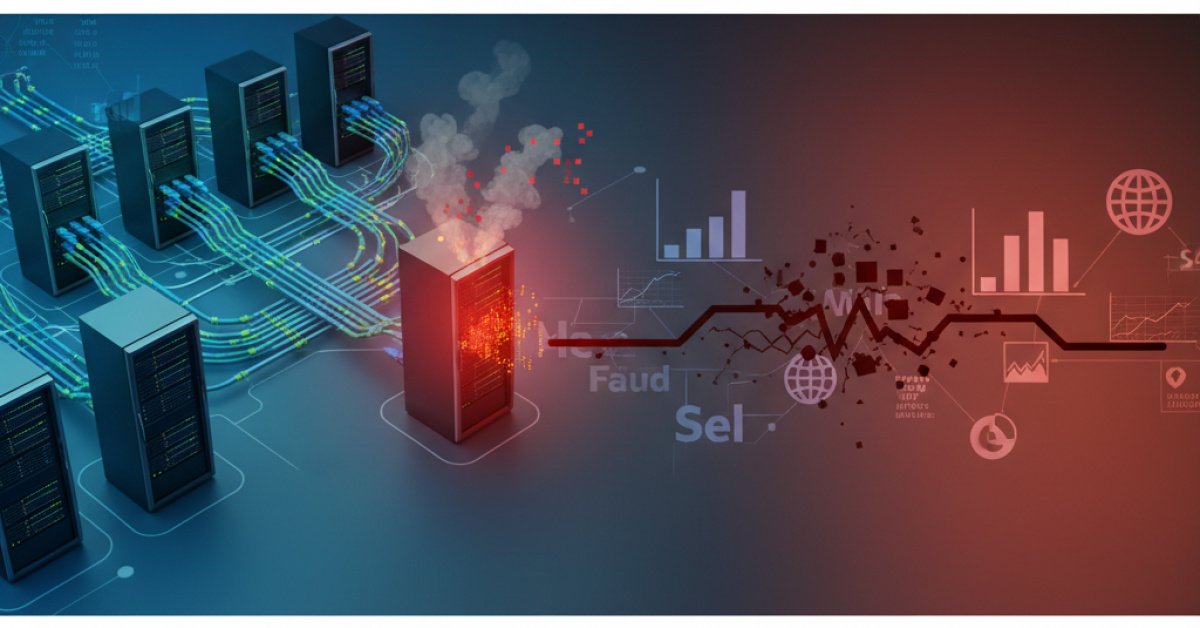
On that particular Friday, the cooling systems at the CyrusOne facility failed. And when you have rooms packed with thousands of powerful, heat-generating servers, a cooling failure is catastrophic. Things overheated, systems shut down, and just like that, the exchange went dark.
For 10 long hours, a critical piece of the global financial machine was offline. It was a complete standstill. And it all came down to a failure in what many would consider basic infrastructure.
A Ripple Effect That Shook the Markets
When we say this "roiled world markets," what does that actually mean?
Think of it like a major highway suddenly closing during rush hour without any warning. CME is where countless traders, banks, and corporations go to manage their financial risk by buying and selling futures and options.
When it went down, all of that activity just… stopped.
- Traders couldn't execute orders.
- Companies couldn't hedge their risks against price swings.
- Billions, if not trillions, of dollars in assets were in a state of limbo.
The outage created a huge cloud of uncertainty. It was a stark reminder of how interconnected and fragile our modern financial systems can be. One point of failure in a building you’ve probably never heard of can have a direct impact on the global economy.
The Aftermath: A Scramble for a Fix
As you can imagine, the pressure was immense. CyrusOne eventually got things back online, but the damage to their reputation—and the trust of their clients—was done.
In the aftermath, they announced they were bolstering their backup cooling capacity. It’s the right move, of course, but it’s also a reactive one. It’s like buying a better fire extinguisher after a fire. The incident exposed a vulnerability that, frankly, shouldn't have existed in a facility this critical.
And this is where the real lesson begins for the rest of us.
The Insurance Lesson We All Need to Learn from This
This entire event is a massive, flashing neon sign for anyone in business, especially when it comes to risk and insurance. It’s a real-world, high-stakes case study that’s way more interesting than any textbook.
It's Not Just About Your Building (Hello, Contingent Business Interruption)
Here’s the most important takeaway: CME Group’s own offices were probably fine. Their power was on, their AC was humming. But they were completely dead in the water. Why? Because a key supplier went down.
This is a textbook scenario for something called Contingent Business Interruption (CBI) insurance.
Your standard Business Interruption (BI) policy helps you recover lost income if your own property suffers a covered loss (like a fire or storm) that forces you to shut down.
But CBI coverage is different. It protects you when the property of a key supplier, partner, or customer is damaged, which in turn causes your business to suffer a financial loss. CME wasn't the one with the broken AC, but they absolutely felt the financial pain. Without CBI coverage, they’d be left holding the bag.
So, ask yourself: Who are your "CyrusOnes"?
- Is it a single-source parts manufacturer?
- A cloud provider like AWS or Azure?
- A specialized logistics company?
If any of them go down, do you go down with them? If the answer is yes, you need to be talking about CBI with your insurance advisor.
Was "Overheating" Even a Covered Peril?
This gets into the nitty-gritty, but it's incredibly important. Insurance policies don't cover everything. They cover specific "perils," or causes of loss.
A standard policy might cover fire, wind, or theft. But would it cover an outage caused by an internal equipment malfunction like an AC failure? Maybe, maybe not. It often depends on if that malfunction leads to a subsequent covered peril, like a fire.
This is why specialized equipment breakdown or even cyber policies (which can cover system failures) are so critical. You can't just assume your property policy will cover every scenario that shuts you down. You have to dig into the policy language and understand what triggers your coverage.
A Wake-Up Call for Your Own Risk Management
Finally, this is a story about the limits of insurance. A good policy can help you recover financially, but it can't get you back those 10 hours of lost operations or undo the damage to your reputation.
The CME outage is a powerful argument for proactive risk management. It’s about doing the hard work before a disaster strikes. This means:
- Due Diligence: Really vetting your critical vendors. What are their backup systems? Have they been tested? Can you see the audit reports?
- No Single Points of Failure: Are you 100% reliant on one provider for a critical function? This event shows just how dangerous that can be. Diversifying vendors or having redundant systems is no longer a luxury; it's a necessity.
- Reviewing Your Plan: It's not enough to have a business continuity plan sitting on a shelf. You have to test it, update it, and make sure it accounts for these kinds of third-party failures.
At the end of the day, the story of the CME outage isn't just about finance or technology. It's about vulnerability. It shows how one simple, physical failure can cascade into a massive digital crisis. For anyone running a business, it's a lesson we can't afford to ignore. Take a good, hard look at your own operations and ask the tough questions. You’ll be glad you did.