Let’s have an honest chat for a minute. If you’ve been in the insurance industry for more than a week, you know the struggle. It’s the constant, low-grade headache that never quite goes away: bad data.
It’s the claim that gets held up because a policy number was entered with a typo. It’s the marketing campaign that falls flat because your customer list is a jumbled mess of duplicates and outdated addresses. It’s trying to get a clear picture of a single customer when their information is scattered across a dozen different, ancient systems that refuse to talk to each other.
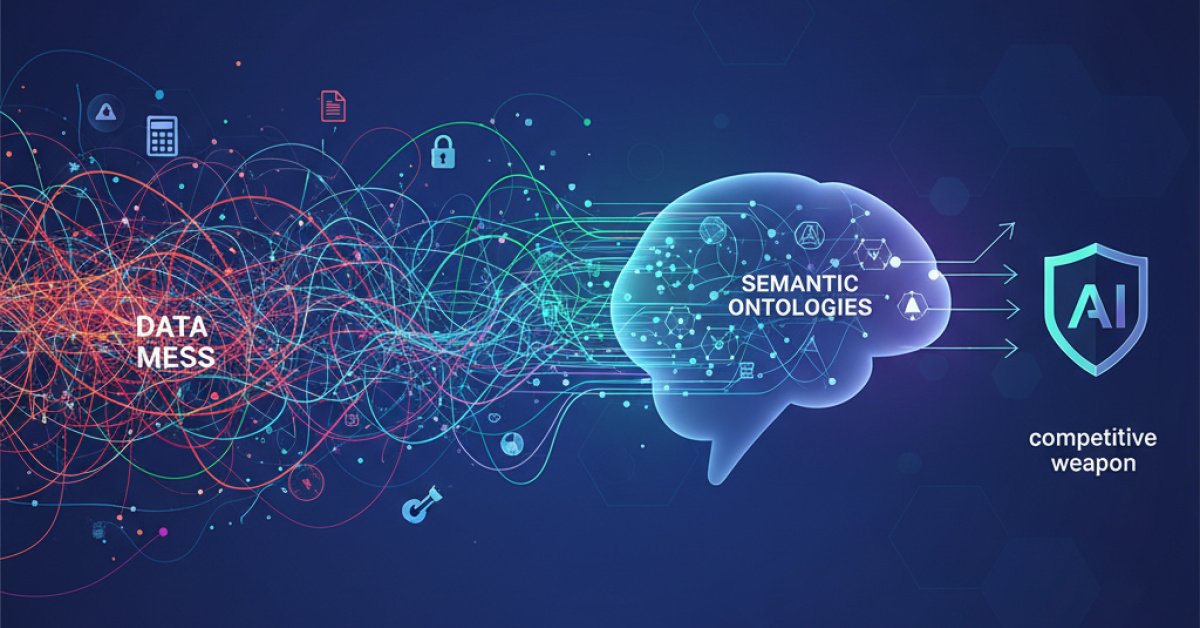
Sound familiar? I thought so. For decades, we’ve treated data quality as a chore—a necessary evil we have to deal with. But what if I told you that’s completely the wrong way to look at it? Some of the smartest folks in the industry are now treating data not as a problem to be cleaned, but as a competitive weapon to be sharpened.
And they’re doing it with a powerful one-two punch: Artificial Intelligence (AI) and something called a “semantic ontology.” I know, that second one sounds like a mouthful, but stick with me. I promise to break it down in a way that actually makes sense.
Let’s Be Real: Why Is Our Data Such a Mess Anyway?
Before we get to the solution, let’s just acknowledge the chaos. Why is insurance data so notoriously tricky? It’s not because people are bad at their jobs. It’s because our industry is built on a patchwork of systems.
Think about it. Your company has probably been around for a while. You’ve got a legacy system for life insurance, a different one for auto, and maybe another one you inherited from that smaller agency you acquired five years ago.
Each system has its own language.
- The life insurance system calls a person the “policyholder.”
- The auto system calls them the “named insured.”
- The marketing database just calls them a “contact.”
They’re all talking about the same person—Jane Doe, who has three different policies with you—but the systems have no idea. To them, it looks like three different people. It’s like trying to assemble a piece of furniture when the instructions are written in three different languages. You’re going to end up with a wobbly table and a pile of leftover screws. That’s our data problem in a nutshell.
How AI Is Becoming the Ultimate Data Detective
This is where the first part of the solution, AI, steps in. Now, when people hear "AI," they often think of robots and sci-fi movies. But in this case, think of AI as a super-smart, incredibly fast detective.
You could hire a whole army of people to manually go through your databases, cross-referencing spreadsheets and looking for errors. But they’d be slow, they’d make mistakes, and they’d probably quit after a month.
An AI, on the other hand, can scan millions of records in the blink of an eye. It’s trained to spot patterns and anomalies that a human would miss.
It can see things like:
- "This address says 'New Yrok,' which is probably a typo for 'New York.'"
- "This person's birth date makes them 150 years old. That can't be right."
- "These three customer profiles have the same address and a similar name. They're likely the same person."
AI is fantastic at finding the clues and flagging the problems. But it has a limitation. It’s great at identifying that "policyholder" and "named insured" might be related, but it doesn't inherently understand what they mean. It lacks context. For that, it needs a partner.
Okay, What on Earth Is a 'Semantic Ontology'?
This brings us to the secret sauce. That term—semantic ontology—sounds way more complicated than it is.
Think of it like a universal translator and a company-wide dictionary, all rolled into one.
An ontology creates a map of your business knowledge. It officially defines all the key concepts and, crucially, how they relate to each other.
It establishes a single source of truth that says:
- A "Person" can be a "Customer."
- A "Customer" can also be a "Claimant."
- A "Customer" owns a "Policy."
- A "Policy" covers an "Asset" (like a car or a house).
- The terms "named insured," "policyholder," and "client" all refer to the same core concept: our "Customer."
Suddenly, the language barrier between your different systems disappears. The ontology provides the context—the meaning—that was missing. It’s the Rosetta Stone for your company’s data.
When AI and a Common Language Team Up, Magic Happens
Now, let’s put the two pieces together. This is where things get really powerful.
The ontology gives the AI the "rulebook." The AI, our super-fast detective, now has a map that explains what everything means and how it all connects.
So, when the AI scans the data, it’s not just guessing anymore.
- It sees the term "named insured" in the auto system.
- The ontology tells it, "That means the same thing as 'policyholder' in the life system."
- The AI can then confidently link Jane Doe's auto policy and her life insurance policy together, creating a single, unified view of her as a customer.
This isn't just about cleaning up typos anymore. This is about creating true understanding. You’re not just correcting data; you’re enriching it. You’re connecting the dots to see the whole picture for the first time.
This Sounds Cool, But What Does It Actually Do for Us?
This is the most important question, right? All this tech is useless if it doesn’t translate into real-world results. And believe me, it does. When you turn your messy data into a clean, connected, and intelligent asset, everything changes.
Sharper Underwriting and Pricing
Imagine an underwriter looking at a new application. Instead of just seeing the information on that one form, they can instantly see the applicant's entire history with your company—every policy, every claim, every interaction. This complete picture allows for much more accurate risk assessment and, ultimately, more profitable pricing.
Faster, Smarter Claims
When a claim comes in, the adjuster doesn't have to hunt through three different systems to verify coverage. The information is all there, connected and clear. This speeds up the process for legitimate claims (which makes customers happy) and makes it much easier for AI-powered tools to spot the red flags of potential fraud.
A Customer Experience That Isn't Awful
Let's face it, our industry isn't exactly known for amazing customer service. A lot of that comes down to siloed data. With a unified view, your service reps can see everything about a customer on one screen. You can finally stop asking people for information you should already have. You can even proactively offer them products or discounts that actually make sense for them based on their complete profile.
This is what it means to turn data into a competitive weapon. While your competitors are still struggling with their wobbly tables and piles of leftover screws, you’re operating with a crystal-clear blueprint. You can move faster, make smarter decisions, and build better relationships with your customers.
This isn’t some far-off future fantasy. It’s happening right now. The insurance companies that are embracing this combination of AI and smart data structures are the ones who are pulling away from the pack. It’s a fundamental shift from just collecting data to truly understanding it. And in this business, understanding is everything.