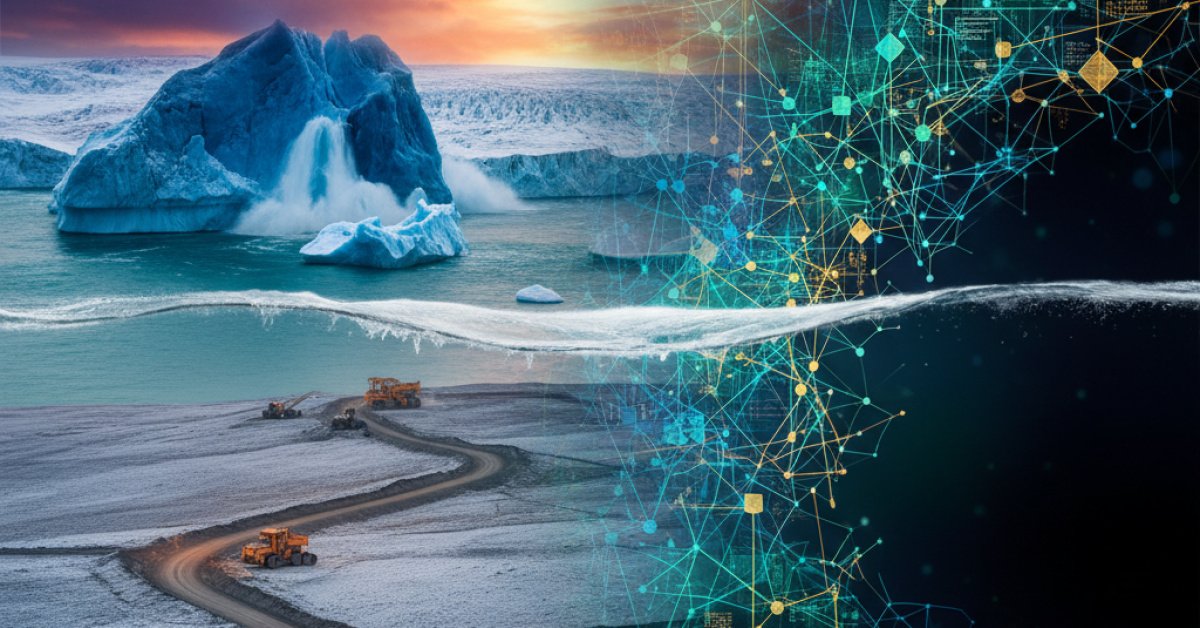
Let’s go somewhere for a minute. Picture yourself in a boat on the Kobuk River in Northwest Alaska. It’s late September, but massive chunks of ice are already drifting by, which feels… wrong. Ahead of you, your great-uncle is scanning the riverbanks, rifle at the ready, looking for caribou.
This isn’t a vacation. This is life. This is how Tristen Pattee and his family have put food on the table for generations. But everything is changing. The ice, the river, the migration patterns of the animals—the very rhythm of their existence is being thrown off-kilter by a warming climate.
Now, you might be thinking, "Okay, that's a powerful story, but what does it have to do with insurance?"
Everything. Absolutely everything. What we're seeing in the Arctic is a real-time, high-stakes preview of a future that the insurance world is scrambling to understand. It’s a story about risk, and what happens when risk stops being a possibility and starts becoming a certainty.
The Ground is Literally Shifting
When we talk about climate change, we often think of far-off polar bears on melting ice floes. But for people in Alaska, the threat is right under their feet. The permafrost—the permanently frozen ground that underpins everything from houses to roads—is thawing.
Imagine building your home on what you thought was solid rock, only to discover it’s slowly turning to mud. That’s the reality. Foundations are cracking. Roads are buckling. Entire buildings are sinking.
From an insurance perspective, this is a nightmare. How do you write a homeowner's policy when the very land the home is built on is fundamentally unstable?
It’s not just the slow-motion disaster of thawing ground, either. The weather is getting weirder and more violent.
- Melting Ice: Rivers that were once reliable frozen highways for months are now unpredictable and dangerous.
- Coastal Erosion: Entire coastal villages, home to Indigenous communities for centuries, are literally washing into the sea.
- Changing Ecosystems: The animal migrations people depend on for sustenance are becoming erratic.
Each of these isn't just an "environmental issue." It's a risk. A risk to property, a risk to business, and a risk to life itself. And insurance, at its core, is the business of managing risk. But the models we’ve used for a hundred years are starting to break down in the face of these new realities.
A 211-Mile Road to a Breaking Point?
Now, let's add another layer of complexity. A massive, controversial industrial road is being proposed, cutting 211 miles through this fragile wilderness. It’s called the Ambler Road, and it’s meant to service a new mining district.
Proponents talk about jobs and economic opportunity. But for the communities that live there, and for anyone looking at this through the lens of risk, it’s like pouring gasoline on a fire.
Think about it. This road would have to cross nearly 3,000 streams and rivers and slice directly through the migration path of the Western Arctic caribou herd—the very animals Tristen Pattee and his family depend on.
Let’s translate this into insurance-speak.
- Environmental Liability: What happens if the road construction or mining operations pollute the rivers? The cleanup costs would be astronomical. Who insures that?
- Business Interruption: For the communities that rely on hunting and fishing, disrupting the caribou migration isn’t an inconvenience; it’s a catastrophic business interruption. But you can’t exactly file a claim for a lost way of life.
- Property Damage: Building a massive road on thawing permafrost is an engineering gamble of epic proportions. The potential for washouts, sinkholes, and structural failure is immense.
The road represents a massive injection of new, unpredictable risk into an environment that is already past its tipping point. It’s forcing a question that the insurance industry is starting to ask all over the world: At what point does a risk become so great, so certain, that it’s simply uninsurable?
When Insurance Stops Working
Here’s a little inside baseball on how insurance works. It’s based on the idea of pooling unpredictable risk. We all pay a little bit into a big pot (premiums) so that if something bad and unexpected happens to one of us, the money is there to cover the loss.
The key word there is "unexpected."
Insurance models are built on historical data. They look at the past to predict the future. But climate change is rewriting the rulebook. The past is no longer a reliable guide for what's coming.
When the risk of a flood, a wildfire, or a collapsing coastline becomes a near certainty for a specific area, the model breaks.
- Premiums would have to be so high that no one could afford them.
- Or, insurers do the only other logical thing: they stop offering coverage altogether. They "exit the market."
We're already seeing this happen. In parts of California, getting fire insurance is becoming nearly impossible. In Florida, the cost of flood and hurricane insurance is skyrocketing as insurers pull back.
Alaska’s Arctic is the canary in the coal mine. It’s a place where the changes are happening so fast and so dramatically that it’s showing us the limits of our traditional insurance system. You can’t insure a community against the certainty of the land washing away. You can’t put a price on the collapse of an ecosystem that has sustained a culture for millennia.
This Isn't Just an Arctic Problem
It’s easy to read this and think of it as a distant problem, something happening to other people in a place most of us will never visit. But that would be a mistake.
The challenges facing insurers in the Arctic are a more extreme version of the challenges we're all about to face. The instability, the unpredictability, the risks becoming certainties—this is coming for all of us. The same forces threatening the homes along the Kobuk River are driving up the cost of your homeowner's insurance, your car insurance, and the price of goods at the grocery store.
The insurance industry is on the front lines of this. We see the claims coming in. We see the models failing. And we know that we can't just keep raising premiums forever. Something has to give.
What’s happening on that river in Alaska isn’t just a story about ice and caribou. It’s a wake-up call. It’s a story about the real-world, financial consequences of a changing planet. It forces us to ask some really tough questions about what we value, what we can protect, and what we’re willing to risk. And for some things, like a way of life passed down through generations, once it's gone, there's no insurance policy in the world that can bring it back.