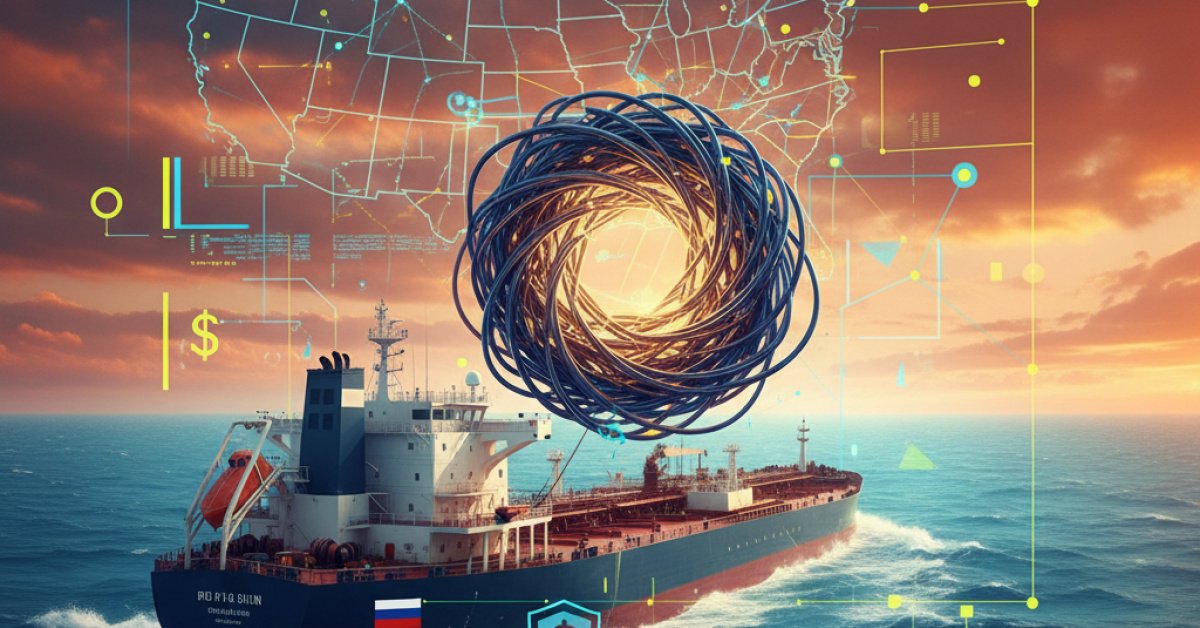
You probably saw the headlines. A massive oil tanker, flagged in Russia and linked to Venezuela, gets seized by the U.S. government out on the open ocean. It’s the kind of stuff you see in movies, right? A real geopolitical chess move in the high-stakes game of global oil.
Most people read that and think about politics, sanctions, and international relations. But when I see a story like that, my brain immediately goes somewhere else. I start thinking about the phone calls lighting up switchboards in London, New York, and Bermuda. I think about the underwriters with their heads in their hands, the brokers scrambling for information, and the shipowner staring at a potential financial catastrophe.
Because behind the political drama is a massive, tangled, and incredibly expensive insurance question: Who pays for a ship that’s just been taken by a world superpower?
Let’s pull back the curtain on this, because it’s a fascinating look at how insurance really works when things go sideways on a global scale.
First Off, What Kind of Insurance Even Covers a Giant Oil Tanker?
Before we get into the seizure, you need to understand that insuring a supertanker isn't like insuring your Toyota. You can't just go online and get a quote. We're talking about an asset worth tens, sometimes hundreds, of millions of dollars.
The insurance is split into a few key types, but let's focus on the two big ones:
- Hull & Machinery (H&M): Think of this as the comprehensive auto insurance for the ship itself. It covers physical damage to the vessel—the hull, the engines, the equipment. If it hits an iceberg, runs aground, or catches fire, the H&M policy is what pays to repair or replace it.
- Protection & Indemnity (P&I): This is the monster liability coverage. P&I insurance is usually handled by "Clubs," which are basically mutual insurance associations owned by the shipowners themselves. This policy covers almost everything else: oil spills and pollution cleanup (a huge one!), damage to other ships or docks, injury or death to the crew, and even the cost of removing a shipwreck.
So, you’ve got one policy for the ship itself, and another for all the chaos the ship might cause. Simple enough, right? Well, not so fast.
The Real Question: Is Government Seizure a Covered "Peril"?
Here’s where it gets incredibly tricky. Your standard Hull & Machinery policy is designed for everyday marine risks—what we call "perils of the sea." Things like heavy weather, collisions, and fires.
But a government deciding to seize your vessel? That’s not a "peril of the sea." That’s a peril of politics.
Most standard marine insurance policies have what we call an "F.C.&S." clause, which stands for "Free of Capture & Seizure." It’s a very old clause that basically says, "Hey, we'll cover you for storms and accidents, but if a government, pirate, or revolutionary group takes your ship, you're on your own."
So, is the shipowner just out of luck? Not necessarily.
To cover this exact risk, you have to buy a separate policy: War Risks Insurance. Despite the name, it covers more than just traditional warfare. It specifically adds back coverage for things excluded by that F.C.&S. clause, including:
- Capture
- Seizure and arrest
- Detainment by political or administrative action
- Strikes, riots, and civil commotions
So, the first thing the shipowner’s broker would do is pull out that War Risks policy and start reading the fine print. But even then, the fight is just beginning.
Sanctions: The Insurance Policy's "Get Out of Jail Free" Card
Now, let’s add the real-world complexity of this specific event. The tanker was Russian-flagged and linked to Venezuela. Both countries are heavily sanctioned by the United States and other Western nations.
This is, frankly, an underwriter’s worst nightmare.
Every modern marine insurance policy contains sanctions exclusion clauses. These clauses are ironclad. They state that if paying a claim, providing coverage, or even offering assistance would expose the insurer to the risk of violating any applicable sanctions, the policy is void.
Think about it from the insurer's perspective. Most of the world's major insurers are based in the UK, Europe, or the U.S. They are legally bound to follow the sanctions imposed by their governments. If they pay a multi-million dollar claim on a seized tanker that benefits a sanctioned entity—even indirectly—they could face massive fines, legal action, and the loss of their license to operate.
So the insurer’s legal team is going to be asking some tough questions:
- Who truly owns this vessel? Is it a sanctioned individual or company?
- Who is the operator? Are they on a sanctions list?
- Would paying this claim be seen as "providing a financial service" to a sanctioned entity?
If the answer to any of these is "yes" or even "maybe," the insurer will likely deny the claim immediately, citing the sanctions clause. It’s their ultimate protection in a messy political situation.
What About the Cargo? (And Why It Matters That the Ship Was Empty)
The original report mentioned the tanker was empty, which actually simplifies things a bit. If it had been carrying a million barrels of crude oil, we’d have a whole other set of problems.
The oil itself would have been covered by a separate Cargo Insurance policy, taken out by the owner of the oil. That cargo owner would now be filing a claim, and their insurer would be going through the exact same painful process we just described. They’d be looking at their own War Risks and sanctions clauses.
This creates a chain reaction of claims and legal battles. The cargo owner sues the shipowner, the shipowner looks to their P&I Club, and everyone points fingers while the lawyers get rich. The fact that the ship was empty at least contains the financial damage to the vessel's owner and their financiers.
So, Who Is Left Holding the Bag?
When a ship is seized and the insurance claims are denied, the financial fallout is devastating.
The shipowner is the most obvious victim. They’ve lost their primary revenue-generating asset. It's just sitting there, not making any money, while they still have to pay the crew, cover port costs (if any), and make payments on the massive loan they took out to buy the ship in the first place.
And that brings us to the bank. Very few companies buy a $100 million ship with cash. They are financed, just like a house. The bank that holds the mortgage on that tanker is now watching its collateral get tangled in an international incident. They have their own insurance (mortgagee's interest insurance), but it's another complex policy that may or may not respond.
Ultimately, a government seizure under these circumstances is a catastrophic loss. It’s a perfect example of a political risk that is incredibly difficult, and sometimes impossible, to insure against.
It’s a stark reminder that in the world of global shipping, you’re not just betting on winds and waves; you’re betting on politics, too. And when that bet goes wrong, the price is higher than almost any insurance policy is willing to pay.