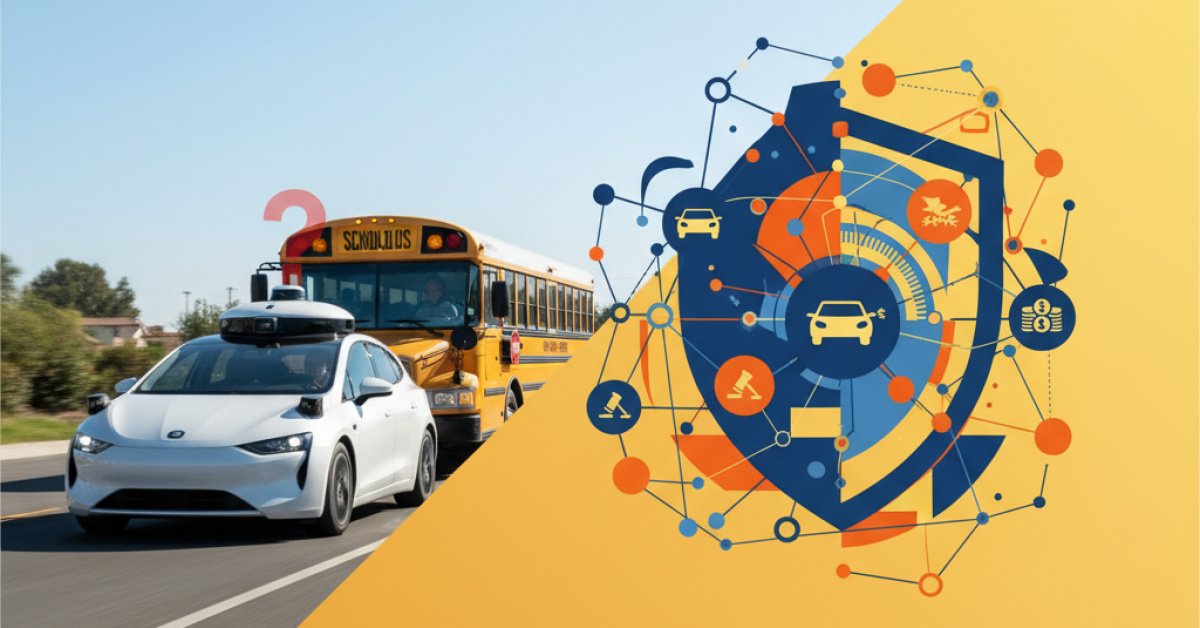
We’ve all been there. You're driving along, and up ahead, you see it: the big yellow school bus, slowing down. The yellow lights start flashing, then the red ones, and that iconic red stop sign swings out from the side. Every driver on the road knows exactly what this means. You stop. Period. It's one of the most ingrained, non-negotiable rules of the road.
Now, imagine a car—a technologically advanced, multi-million dollar vehicle with no human driver—looking at that exact same scene and deciding to just… keep going.
That’s not a scene from a sci-fi thriller. It’s allegedly what’s been happening in Texas, where federal officials are now looking into reports of Waymo’s self-driving cars illegally passing school buses. And let me tell you, as someone who lives and breathes insurance, this story is setting off some major alarm bells. This isn't just a traffic ticket issue; it's a fundamental test of a technology that we're being told is the future, and it has massive implications for risk, liability, and the entire insurance industry.
So, What Exactly is Going On?
Let's break down what we know. A U.S. safety agency has officially asked Waymo—which is owned by Google's parent company, Alphabet—for more information about this. Why? Because officials in Texas have reported a startling pattern.
They've logged 19 different incidents of Waymo's autonomous vehicles illegally passing school buses since the current school year began. Nineteen.
Think about that for a second. These aren't just random traffic violations like a rolling stop or forgetting a turn signal. This is a failure to recognize one of the most critical safety signals on our roads, one designed specifically to protect children. It’s a scenario that makes your stomach drop, and it’s precisely the kind of event that makes insurance underwriters lose sleep at night.
Why This is Such a Nightmare Scenario for Insurers
When we talk about self-driving cars, the big promise has always been safety. The pitch is that by removing human error, we can make the roads dramatically safer. And in many ways, the technology is incredible. But incidents like this expose the massive, complicated gray areas that still exist.
From an insurance perspective, this situation is a perfect storm of concerns.
The Liability Puzzle Just Got Harder
With a human driver, liability is usually straightforward. If you run a school bus stop sign and cause an accident, you (and your insurance) are responsible. But when the car is driving itself, who’s on the hook?
- Is it Waymo, the operator of the service?
- Is it Alphabet, the parent company?
- Is it the programmer who wrote the line of code that failed to recognize the bus?
- Is it the manufacturer of the sensor that didn't "see" the stop sign correctly?
This is the billion-dollar question that the legal and insurance worlds have been grappling with for years. We've moved from personal liability to product liability, and that is a much murkier, more expensive world to insure. Each of these incidents in Texas is a potential test case for where that blame will ultimately land.
How Do You Price a Policy for an Unknown?
Think about how your own car insurance is calculated. Insurers look at your driving record, your age, the car you drive, where you live—decades of data on human behavior.
Now, how do you underwrite a fleet of autonomous vehicles? You rely on the data the company gives you. You trust that the system is programmed to obey fundamental traffic laws. But when it fails at something as basic as a school bus stop, it calls the entire risk model into question.
An underwriter has to ask: If the AI can't handle this, what other "simple" rules of the road might it misunderstand? What other edge cases haven't been accounted for? Suddenly, the risk you thought you were insuring looks completely different. It makes it incredibly difficult to price a commercial auto policy for a company like Waymo with any degree of confidence.
Public Trust is Everything
At the end of the day, insurance is a business built on trust. And so is the entire future of autonomous vehicles.
If parents see videos of driverless cars zipping past their kids' school bus, they aren't going to want those vehicles on their streets. That public backlash can slow down or even halt the adoption of the technology. For insurers who are investing in creating new products for this market, a collapse in public trust is a massive financial risk. It could mean building an entire line of business for a market that fails to materialize.
What Happens Now?
The federal probe is just the first step. They'll be digging into Waymo's data, trying to understand why these failures happened. Was it a software bug? A hardware limitation? A problem with how the AI interprets the world around it?
The answers will have a ripple effect across the entire industry. We'll likely see new regulations and stricter testing requirements for autonomous vehicles, especially around sensitive areas like schools. For insurers, this will mean going back to the drawing board, reassessing the risk, and potentially rewriting policies to account for these newly-exposed vulnerabilities.
This isn't a story about condemning the technology. It’s about acknowledging the enormous challenges that lie between where we are now and a future where autonomous vehicles are a safe, everyday reality. Each of these incidents is a critical, real-world data point. It’s a lesson being learned in public, and for the insurance industry, it's a stark reminder that the road to the future is going to be a lot bumpier—and more complicated to insure—than we might have thought.