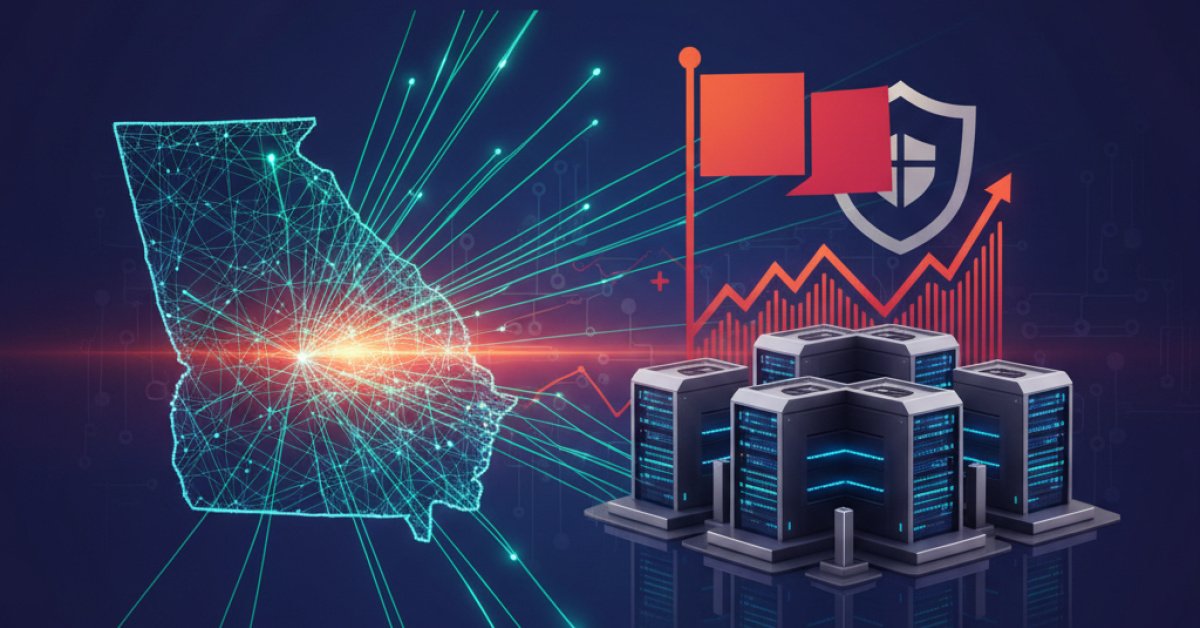
Have you seen the news coming out of Georgia? It might look like a boring headline about utility regulations, but trust me, for those of us in the insurance world, it’s a flashing neon sign.
Georgia’s state regulators just gave the green light for a plan to boost power generation capacity by a whopping 50%. And why the massive increase? Almost entirely to feed the insatiable appetite of new data centers flocking to the state.
On the surface, it’s a story about economic growth and digital infrastructure. But if you're a risk manager, an underwriter, or a broker, you should be sitting up and paying close attention. This isn't just about keeping the lights on; it's about a fundamental shift in risk concentration that we’re going to have to grapple with, and fast.
So, What's Really Going On Here?
Let’s break it down in simple terms. Imagine your town's entire power grid. Now, imagine the local utility company announcing they need to build enough new power plants to make that grid one and a half times bigger. That’s the scale we’re talking about.
The decision from Georgia’s regulators was unanimous (5-0), which tells you how much pressure there is to meet this demand. These data centers—the physical homes for the cloud, AI, and pretty much everything we do online—are incredibly power-hungry. They are the digital factories of the 21st century, and they need a staggering amount of electricity to run and stay cool.
This isn’t a slow, gradual increase. It’s a massive, accelerated build-out, one of the biggest in the country. And when things move that fast and that big, risk follows right behind.
The Billion-Dollar Question: Why Should We in Insurance Care?
Okay, so more power plants and more data centers. Why does this land on our desk? Because this development is creating a perfect storm of interconnected risks that we'll be asked to insure.
Think of it this way: we’re not just insuring a building full of servers anymore. We’re insuring a highly concentrated, incredibly valuable, and deeply fragile ecosystem.
A Mind-Boggling Concentration of Risk
I want you to picture this. We’re seeing more and more of these multi-billion dollar data centers being built in the same geographic areas, like "Data Center Alley" in Virginia or what's now happening in Georgia.
It’s like building all the world's most valuable libraries on the same earthquake fault line.
From an underwriting perspective, this is terrifying. A single event—a tornado, an ice storm that takes down the grid, a sophisticated cyberattack—doesn't just threaten one facility. It threatens a whole cluster of them. The potential for a catastrophic loss event that affects multiple policies simultaneously is enormous. The aggregation of risk is unlike almost anything we've seen before.
How are we modeling our probable maximum loss (PML) for something like this? Are we truly accounting for the cascading effects of a regional power failure that could take dozens of these critical facilities offline at once? Frankly, I have my doubts.
The Underwriting Headache: Business Interruption on Steroids
Let’s talk about Business Interruption (BI). The BI exposure for a single data center is already massive. But it’s the ripple effect that should keep us up at night.
A data center doesn’t just have its own BI. It has thousands of tenants—banks, retailers, healthcare systems, tech companies—all of whom will have their own Contingent Business Interruption (CBI) claims if that data center goes down.
Now, add the power grid to the mix. The stability of that grid is the single most critical dependency. If this rapid build-out puts a strain on the system, or if one of the new power sources proves unreliable, the potential for widespread outages is very real. We’re not just underwriting the data center anymore; we’re indirectly underwriting the stability of an entire regional power grid that’s undergoing massive, rapid change.
Don't Forget the Construction Phase
Before these data centers can even start humming, they have to be built. And so do the power plants that will feed them. This Georgia plan kicks off a monumental construction boom.
That means a surge in demand for:
- Builders' Risk Policies: These are complex, high-value projects with tight timelines. Any delay, accident, or supply chain issue can lead to a huge claim.
- Professional Liability (E&O): The architects and engineers designing these facilities and the power infrastructure are under immense pressure. A single design flaw could be catastrophic.
- Workers' Compensation: More projects and faster timelines can unfortunately lead to more workplace accidents.
This is a huge opportunity for carriers, of course. But the complexity and sheer scale of these projects require deep expertise. There’s not a lot of room for error when you’re insuring the construction of a billion-dollar facility.
What Does This Mean for Us Going Forward?
This Georgia decision isn’t an isolated event. It’s a preview of what’s coming to other states as the demand for data and AI continues to explode. It’s a wake-up call.
We, as an industry, need to get smarter about how we approach these risks. We need to be asking tougher questions during the underwriting process. It’s no longer enough to ask about a data center’s fire suppression or backup generators.
We need to be asking:
- What is the stability of the regional power grid?
- How much risk is concentrated in this specific geographic "cluster"?
- What is the true cascading failure potential for a grid-down event?
- Are our models sophisticated enough to even calculate the potential aggregation of CBI claims?
It's a fascinating and, let's be honest, slightly daunting development. This isn't just a local news story about power lines. It's a signal of a massive shift in the risk landscape, and it’s happening right now. We all need to be watching this space, because the decisions being made in a Georgia regulatory meeting today will be shaping the claims we pay for years to come.