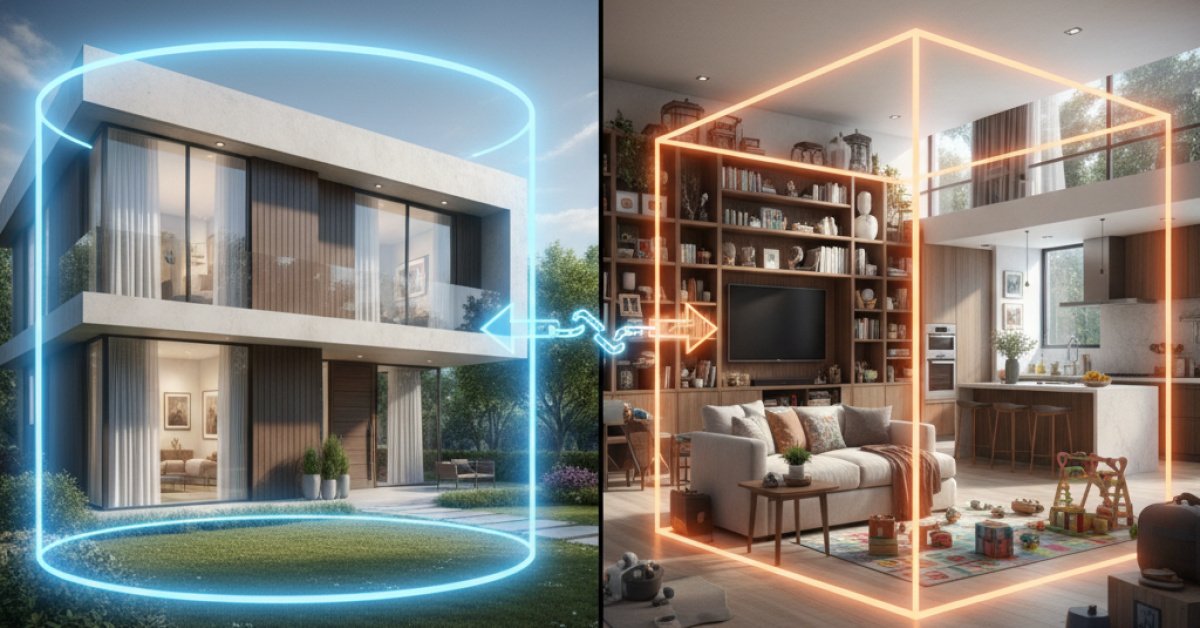
Let’s talk about something that’s always struck me as a bit strange in the world of home insurance. We’re obsessed with the house itself. I mean, truly obsessed.
Before an insurer writes a policy, we pull up everything we can find. We know the square footage, the year it was built, the type of roof, and the last time a permit was pulled for the plumbing. We use aerial imagery, deed records, weather data, you name it. We can tell you more about the structure of a house than the person living in it probably knows.
But here’s the crazy part. For the most part, we have absolutely no idea what’s inside it. And that, my friends, is arguably the biggest blind spot in our entire industry.
We're Judging the Book by Its Cover
Think about it like this. Imagine two identical-looking houses, side-by-side on the same street. They're both 2,000-square-foot colonials built in 1995. From the outside, and based on all that public data we love, they are the exact same risk. So, they should pay the same premium, right?
But what if I told you one house is occupied by a minimalist who furnishes their home with second-hand finds, and the other belongs to an art collector with a passion for high-end electronics and designer furniture?
Suddenly, the picture changes completely. The risk isn't the same at all. One fire or one burglary would result in two wildly different claims. Yet, traditionally, we've treated them as if they're carbon copies. We’ve been so focused on the shell that we’ve completely ignored the valuable, fragile, and highly variable stuff within it.
What Exactly Are We Missing?
When we only look at the property from the outside, we're missing the entire story of the life lived within its walls. This isn't just about a few nice pieces of furniture. The value of a home's contents can be massive and incredibly diverse.
We're talking about things like:
- High-end electronics: Multiple 4K TVs, sophisticated sound systems, top-of-the-line computers.
- Luxury goods: Designer handbags, expensive watches, and fine jewelry.
- Collections: Artwork, wine, rare books, or valuable antiques.
- Specialty equipment: Professional-grade camera gear, expensive sporting equipment, or high-end kitchen appliances.
The list goes on and on. The total value of these items can easily eclipse the cost of repairing a roof or replacing a wall. By not having any insight into this, we’re essentially flying blind. We're trying to price the risk of an entire puzzle with half the pieces missing.
Why This "Contents Blind Spot" Is a Problem for Everyone
This isn't just an academic exercise. This gap in knowledge creates real-world problems for both insurance carriers and, more importantly, for you, the homeowner.
For Pricing and Underwriting, It's a Mess
Let's go back to our minimalist and our art collector. The current system is unfair to both of them.
The minimalist is likely overpaying for their insurance. Their premium is based on an assumed level of risk that simply doesn't match their reality. They're subsidizing the higher-risk homeowner down the street.
Meanwhile, the art collector is a huge, unknown risk on the books. They are almost certainly underinsured and are not paying a premium that accurately reflects the potential for a multi-hundred-thousand-dollar claim. It’s a ticking time bomb for the carrier and a recipe for disaster for the homeowner, who might find out they don't have enough coverage only after a total loss.
For Claims, It's an Absolute Nightmare
This is where the rubber really meets the road. When a disaster happens—a fire, a flood, a major theft—the first thing an adjuster needs to know is, "What was lost?"
Without any prior documentation, the burden of proof falls entirely on the homeowner. You're expected to create an exhaustive list of every single thing you owned, often from memory, while dealing with the trauma of the event itself. Can you remember the brand of every kitchen appliance, the purchase date of your sofa, or the model number of your TV? It’s an incredibly stressful and difficult process.
It also puts the claims adjuster in a tough spot. They have to work with the homeowner to piece together a life's worth of possessions with very little information. This friction can lead to delays, disputes, and a deeply unsatisfying experience for a customer who needs help the most. It’s no wonder the claims process is often the most complained-about part of the insurance experience.
The Path Forward: Finally Looking Inside
So, what’s the solution? We can't exactly send an appraiser into every single home before writing a policy. But the good news is, technology is finally starting to give us a window into the home.
We're seeing a shift towards a more collaborative approach. Insurers are developing tools that make it easier for you to document your belongings. Think of mobile apps that let you take a video of your home, using AI to automatically identify and catalogue your possessions. Or simple, guided inventory checklists that help you think through what you own before you ever have to file a claim.
It’s about moving from a system of assumptions to a system of knowns.
When an insurer has a better idea of what they’re actually insuring, everyone wins. Premiums become fairer and more accurate. The minimalist pays a bit less, and the collector gets the right amount of coverage for their prized possessions. And if a claim ever does happen, the process is smoother, faster, and far less painful because a record of your belongings already exists.
It’s a fundamental change in how we view home insurance—from simply protecting the four walls and a roof to protecting the life you’ve built inside them. And frankly, it’s about time.