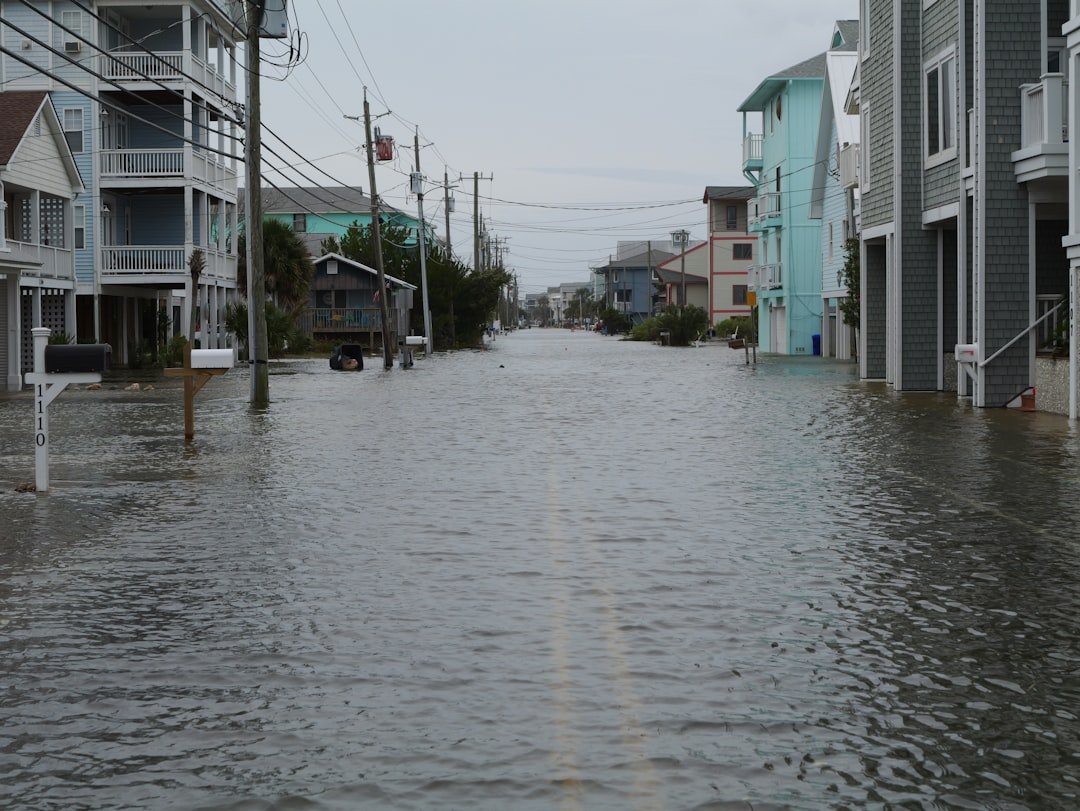
When you picture a flood, what comes to mind? Maybe a river bursting its banks in a rural town, or a coastal community hit by a storm surge. I bet you don't picture the pristine, tree-lined streets of some of London's most exclusive neighbourhoods.
But here's the thing that's catching so many people by surprise: water doesn't care about your postcode.
Just last month, a community hall in the very affluent London neighbourhood of South Hampstead was packed to the rafters. Homeowners were gathered, not for a local festival, but to grapple with a very real, and very wet, new reality. They’re realizing that the threat of flooding isn’t just something they see on the news—it’s lapping at their own front doors.
It's a wake-up call happening across the city, forcing us to rethink what "at-risk" really means.
So, Why Are Posh Postcodes Suddenly on the Flood Map?
It seems counterintuitive, right? These are areas with multi-million-pound properties. But a lot of the risk comes down to something pretty simple: concrete.
Think about it. London is a sprawling, paved-over city. When we get those intense, sudden downpours that are becoming more and more common, where does the water go? In a field, it soaks into the ground. In a city like London, it hits tarmac and tiles and has nowhere to go but sideways.
This creates flash floods, and they can happen anywhere. The city's Victorian-era drainage systems, brilliant as they were for their time, simply weren't designed to handle the sheer volume of water we're seeing today. They get overwhelmed, and the water backs up, often into basements and ground floors.
And here’s a twist: many of these wealthy areas are in low-lying spots or have a unique topography that makes them, surprisingly, more like a bowl. When the rain comes down hard and fast, these beautiful neighbourhoods can become temporary basins.
The Insurance Headache is Getting Worse
As an insurance writer, this is where I see the real-world consequences hit home. For years, if you had a nice house in a "good" area, getting home insurance was pretty straightforward. That's changing, and fast.
Insurers are getting incredibly sophisticated with their risk mapping. They're not just looking at rivers anymore. They're using complex models that account for surface water flooding, sewer capacity, and climate change projections. And their maps are lighting up in places that never used to be considered high-risk.
What about the Flood Re scheme?
You might have heard of Flood Re. It’s a fantastic scheme, a joint initiative between the government and insurers, designed to make flood cover more affordable for homes at high risk. It essentially acts as a giant reinsurance pool.
But here’s the catch, and it’s a big one for residents in these affluent areas: Flood Re has its limits.
- It only covers homes built before 2009. The idea was to discourage building new homes in flood-prone areas.
- It has a council tax band limit. In England, it only covers homes in council tax bands A to G. If your home is in the highest band, Band H, you're not eligible.
Many of the properties in neighbourhoods like South Hampstead, Kensington, and Chelsea fall into Band H. This means they can't access the Flood Re safety net, leaving them exposed to potentially sky-high premiums or, in some cases, difficulty finding an insurer willing to offer flood cover at all.
It's a perfect storm, really. You have a rising risk, increasingly accurate data that proves it, and a safety net that doesn't apply to you.
You Can't Stop the Rain, But You Can Protect Your Home
So, what can you actually do? This is the question everyone was asking at that community meeting, and it’s the one I get asked all the time. Waiting for the council or the government to build massive new infrastructure is a long-term game. You need solutions for right now.
The answer is something called Property Flood Resilience, or PFR.
Think of it like this: If you can't stop the water from reaching your property, you can at least stop it from getting inside. Or, if it does get in, you can make sure it causes as little damage as possible and that you can recover quickly.
It’s all about making your home more robust. Some common PFR measures include:
- Flood Gates: These are removable barriers you can quickly fit to doorways and windows when a flood warning is issued.
- Airbrick Covers: Simple, effective covers that prevent water from flowing through the ventilation bricks in your walls.
- Non-Return Valves: These can be fitted to your drains and pipes to stop sewage from backing up into your home during a flood—a truly horrible, but common, problem.
- Resilient Interiors: This is about thinking ahead. If you're renovating, consider using waterproof plaster, raising electrical sockets higher up the wall, and opting for tiled floors instead of carpets on the ground floor.
The good news is that insurers love this stuff. If you can show them you've taken proactive steps to protect your home, they are often much more willing to offer you cover, sometimes at a better price. It shows you're taking the risk seriously.
This is a Team Sport
While protecting your own home is crucial, this isn't a problem anyone can solve alone. The sheer scale of the risk means we need a community and city-wide approach.
We're seeing residents' associations and local groups becoming incredibly active, lobbying local councils for better drain maintenance and pushing for larger-scale solutions like "rain gardens" or permeable paving that helps absorb water naturally.
It's a shift in mindset. For a long time, we've treated flood defence as something that happens "over there," on a riverbank or at the coast. Now, we have to start thinking about it on our own streets, and even in our own front gardens.
Ultimately, this is our new normal. The climate has changed, and the patterns of rainfall have changed with it. The days of assuming your expensive postcode was an insurance policy against flooding are over. The real insurance now is a combination of a good policy, a well-protected home, and an active, aware community. It’s a lot to take on, I know, but burying our heads in the (soon-to-be-sodden) sand simply isn't an option anymore.