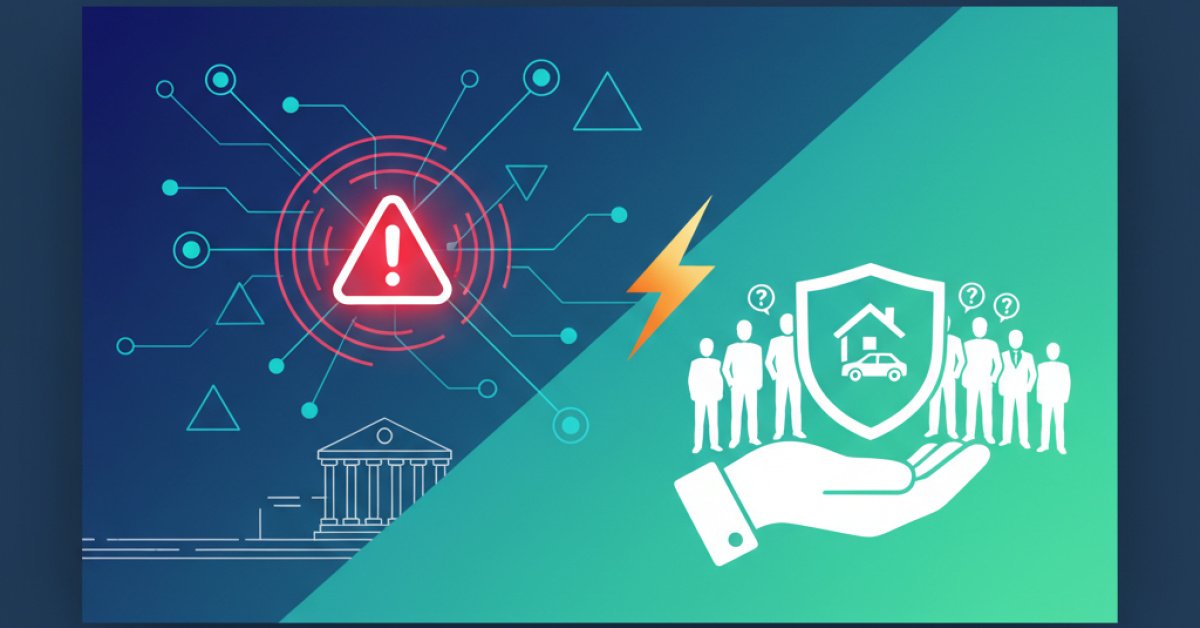
Remember just a few years ago? The chatter in every insurance conference, every webinar, every breakroom was all about AI. The big, scary question on everyone's mind was, "Is a robot going to take my job?"
If you're a commercial underwriter or an actuary, you definitely heard it. The narrative was that sophisticated algorithms would soon be doing everything, leaving seasoned professionals out in the cold. It was a pretty unsettling time, to be honest.
But here’s something interesting. It looks like the panic is starting to fade. A recent look at the industry shows that for every underwriter who's still worried about being replaced by AI, there's another one who isn't concerned at all. The fear factor is dropping.
So, are we all in the clear? Not exactly. It seems we've traded one big, obvious fear for a quieter, more complicated problem: getting the people who build the AI to actually work well with the people who have to use it.
So, What's Really Going On with AI and Underwriters?
Let's be real. The initial wave of fear was understandable. We saw these incredibly powerful tools emerging, and it was natural to wonder where we fit in.
But as we've gotten our hands on these tools, I think many of us have realized something important. AI is a fantastic co-pilot, but it's not ready to fly the plane solo. It can analyze massive amounts of data in a blink, spot patterns we might miss, and handle the repetitive grunt work. That’s a huge win.
What it can't do is replicate the decades of experience, the gut instinct, and the nuanced judgment that a human underwriter brings to the table. It doesn't understand the "why" behind the numbers or the story behind a particular risk.
And that's why the conversation is shifting. We're moving away from "Will AI replace us?" and starting to ask, "How can we make this thing work for us?" Which, it turns out, is a much harder question to answer.
The Real Challenge: The Great Collaboration Gap
Here’s the new problem we're all facing. It’s not a battle between humans and machines. It’s a communication breakdown between two groups of humans: the underwriters and actuaries on one side, and the data scientists and engineers on the other.
Think of it like this: You have a brilliant, world-class chef (the underwriter) who knows everything about flavor, texture, and creating a memorable dining experience. And you have a brilliant, world-class nutritionist (the data scientist) who knows everything about molecular compounds, caloric density, and metabolic impact.
You ask them to create a menu together.
The nutritionist might create a "perfect" meal that is algorithmically optimized for health but tastes like cardboard. The chef might create a delicious masterpiece that ignores all the nutritional data. Both are experts in their own right, but they're speaking different languages and aiming for slightly different goals.
That’s exactly what’s happening in insurance right now. We have data scientists building incredibly sophisticated, statistically "perfect" models. But when they hand them over to the underwriting team, they often don't make sense in the real world of business.
Why Don't Underwriters and Data Scientists Always See Eye-to-Eye?
This isn't about anyone being right or wrong. It's about coming from completely different worlds.
Different Goals, Different Mindsets
A data scientist’s primary goal is often model accuracy. They want to build a predictive engine that is as precise as humanly possible. They live and breathe data, and their definition of success is a statistically sound outcome.
An underwriter's goal is to write profitable business. You have to balance risk, pricing, market conditions, broker relationships, and regulatory rules. A model might be 99% accurate, but if that 1% of inaccuracy leads to a massive, unprofitable loss on a specific account, it's a failure from a business perspective.
You're playing a different game. They're trying to win on points; you're trying to win the championship.
The "Black Box" Problem
Another huge issue is transparency. Many AI models are what we call a "black box." The data goes in, a decision comes out, but the reasoning in the middle is a complete mystery.
As an underwriter, you can't work like that. You need to be able to explain your decisions to brokers, to clients, and sometimes, to regulators. If a model tells you to decline a risk or slap a massive premium on it, you need to know why. "Because the computer said so" is not an acceptable answer.
Forgetting the Human Element
Finally, data scientists often don't have the on-the-ground experience that you do. They haven't spent years building relationships with brokers or walking a factory floor to understand its unique risks.
They see data points. You see a business, a story, and a relationship. That context is everything, and it’s something that can’t be easily fed into an algorithm.
How We Can Start to Bridge This Gap
Okay, so we've identified the problem. How do we fix it? This isn't something that's going to happen overnight, but there are some practical steps we can all take to close that gap between the tech teams and the insurance pros.
-
Create Blended Teams: Stop siloing the data scientists in a separate department. Embed them within the underwriting teams. Have them sit in on meetings, listen to calls with brokers, and truly understand the day-to-day business decisions. When they see the challenges firsthand, their models will get a lot more practical, fast.
-
Teach Each Other's Languages: Underwriters don't need to become expert coders, but a basic understanding of how these models work is crucial. Likewise, data scientists need a crash course in "Underwriting 101." They need to understand concepts like loss ratios, market cycles, and the regulatory environment.
-
Demand Explainability: As an industry, we need to push back against the "black box." We should demand models that are transparent and can explain their reasoning. If a tool can't tell you why it made a recommendation, its value is seriously limited.
-
Focus on Augmentation, Not Automation: The goal of AI shouldn't be to automate the underwriter out of a job. It should be to augment their abilities. The best tools are the ones that handle the data-heavy lifting, freeing you up to do what you do best: apply your judgment, build relationships, and make complex strategic decisions.
Ultimately, this is a culture shift. It’s about moving from a "hand-off" process, where one team builds a tool and throws it over the wall to the next, to a true partnership.
The future of underwriting isn't about choosing between human expertise and artificial intelligence. It's about combining the two. The companies that figure out how to make their chefs and their nutritionists work together in the same kitchen are the ones who are going to create something truly special. And honestly, that's a future that's a lot more exciting than it is scary.