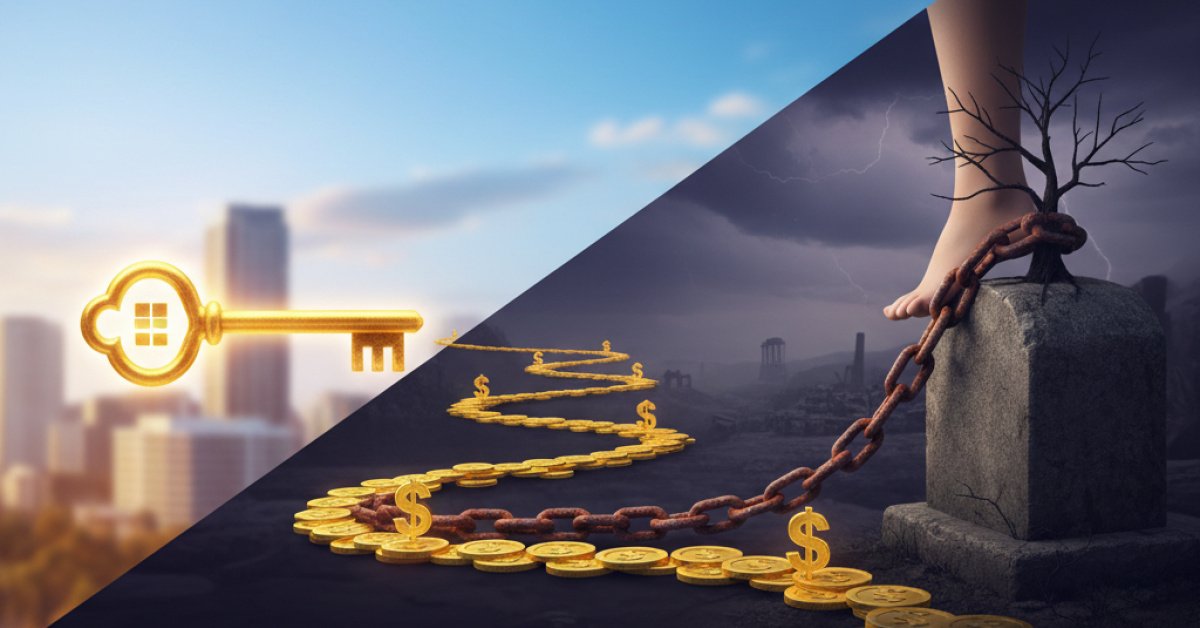
Ever feel like you’ll be paying off your mortgage for the rest of your life? Well, what if that was… literally the plan?
An idea has been floating around for a 50-year mortgage, and it’s one of those things that sounds both intriguing and a little terrifying at the same time. With home prices and interest rates making things tough for so many people, the thought of a lower monthly payment is incredibly tempting.
But before we get too excited, we need to have a real, honest chat about what signing up for a half-century of house payments would actually mean for you and your family. Let’s pull back the curtain on this idea and see if it’s a golden ticket to homeownership or a financial ball and chain.
First, Where Did the 30-Year Mortgage Even Come From?
It’s easy to think the 30-year mortgage has been around forever, but it’s actually a relatively modern invention. Believe it or not, before the post-war era, mortgage terms were much shorter.
The government introduced the 30-year loan back in the 40s and 50s as a way to make homeownership a reality for more Americans and give the economy a boost. It was a game-changer, and by the 1960s, it became the standard way most of us buy a home. So, the idea of stretching that out even further isn't totally out of left field, but it would be a massive shift.
The Big Appeal: A Smaller Monthly Bill
So, why even talk about a 50-year loan? The answer is simple: lower monthly payments.
When you’re staring down the barrel of today’s housing market, any little bit of relief can feel like a lifesaver. Lawrence Yun, the chief economist at the National Association of Realtors, did the math for us.
Let’s imagine you’re taking out a $420,000 loan at a 6.3% interest rate.
- With a standard 30-year mortgage, your monthly payment would be a certain amount.
- With a 50-year mortgage, that same loan would have a monthly payment that’s about $236 lower.
Seeing that number, you might think, "Hey, an extra $236 in my pocket every month sounds great!" And you're not wrong. That could mean less financial stress, more money for groceries, or a little extra for savings. For some people, that difference could be what makes buying a home possible at all.
But, and this is a huge "but," that monthly saving comes with some serious strings attached.
The Hidden Cost: Where the 50-Year Mortgage Gets Ugly
This is the part of the conversation where we have to look at the long-term reality. That small monthly saving comes at a massive cost down the road.
You’ll Build Equity at a Snail’s Pace
Think of building equity in your home like climbing a mountain. With a 30-year mortgage, you’re making steady progress. With a 50-year mortgage, you’re barely moving.
Because you're stretching the payments out over such a long time, a much larger chunk of your early payments goes straight to interest, not to paying down your actual loan balance. How slow is it? Yun points out it would take you nearly 40 years just to pay off half the loan.
This is a huge problem. If you need to sell your home after 5, 10, or even 15 years, you’ll own a tiny sliver of it. Cameron Saemann with Second Story Realty puts it perfectly: you could end up in a situation where it costs you more to sell the home (with realtor fees and closing costs) than the equity you’ve actually built. Ouch.
The Interest is Astronomical
Okay, brace yourself for this number. On that same $420,000 loan, stretching it from 30 to 50 years means you’d end up paying roughly $360,000 more in interest over the life of the loan.
Read that again. Over a third of a million dollars extra.
Joel Berner, a senior economist with Realtor.com, explains that lenders would also likely charge a higher interest rate for a 50-year loan to compensate for their increased risk. So, not only are you paying for a longer time, but you’re also paying at a higher rate. It's a double whammy that dramatically inflates the total cost of your home.
Is This Just a Band-Aid on a Bigger Problem?
Here’s the thing: experts agree that the real reason homes are so unaffordable isn't just the monthly payment. It's that there aren't enough homes to go around, especially in the low- and middle-price ranges.
A 50-year mortgage doesn't build a single new house. What it does is give more people a little more buying power. And what happens when more people are trying to buy the same limited number of homes? You guessed it—prices go up.
The "savings" from a 50-year mortgage could get completely wiped out by the very housing inflation it helps create. It's a classic case of treating the symptom, not the cause.
So, What Are Some Better Ideas?
Instead of just creating longer, more expensive loans, many in the industry believe we should focus on other solutions. Kimber White, president of the National Association of Mortgage Brokers (NAMB), suggests we could be looking at things like:
- Revamping credits for first-time homebuyers.
- Modernizing down payment assistance programs.
- Encouraging partnerships to build more affordable homes.
- Exploring more flexible loan options, like a loan that has an interest-only period for the first few years to help with initial affordability.
These ideas aim to tackle the root causes of the affordability crisis, rather than just stretching out the debt.
The Final Word
Look, the idea of a 50-year mortgage comes from a good place: trying to help people get into a home. The lower monthly payment is a powerful lure, and for some, it might feel like the only way in.
But it’s a deal with a serious downside. You’re trading a little relief now for a future with painfully slow equity growth and a mountain of extra interest. It makes it incredibly difficult to build wealth, move when you need to, or ever feel like you’re truly getting ahead.
It really makes you stop and think. Are we trying to solve the housing problem, or are we just kicking the can down a very, very long road? It’s a question we all need to be asking.