You know that feeling at the airport. You're past security, you've grabbed your overpriced coffee, and now you’re just trying to get to your gate. Sometimes that involves a long walk, a tram, or one of those funny-looking shuttle buses. You hop on, not thinking twice about it. You just assume it's all part of the safe, routine process of air travel.
But what happens when that routine breaks down?
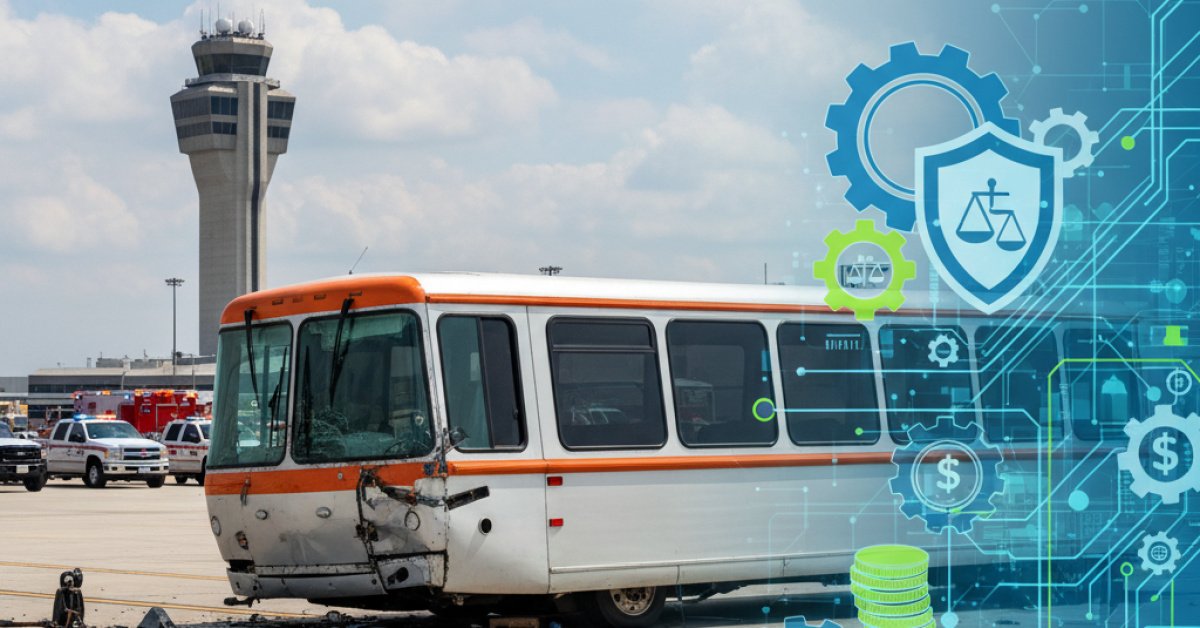
Recently, a "mobile lounge" – one of those massive people-movers that shuttles passengers between the terminal and the plane at Dulles Airport near D.C. – crashed into a dock. It wasn't a minor fender-bender, either. Eighteen people ended up in the hospital. And as soon as I heard the news, my insurance brain immediately started spinning.
Beyond the immediate concern for the injured, an incident like this rips the curtain back on the incredibly complex and usually invisible world of commercial insurance. When something goes wrong on this scale, who's actually on the hook? Let's unpack the insurance fallout from an event like this, because it's a lot more complicated than you might think.
First Off, What Exactly Happened?
The basics of the story are straightforward. A vehicle designed for one purpose—getting passengers safely from point A to point B within the airport—failed in its mission. It struck a part of the building, and the impact was significant enough to cause injuries requiring hospital care for over a dozen people.
For most people, that's where the story ends. But for us, that's where the real questions begin. An accident like this triggers a massive, multi-layered insurance investigation. It's like a giant puzzle where lawyers and claims adjusters have to figure out which policy pieces fit where.
The Big Question: Who’s Liable Here?
This is the million-dollar question, and the answer is rarely simple. It's not like a two-car accident on a city street where you can just point a finger at one driver. In a commercial environment like an airport, liability can be a tangled mess.
Think of it like a knotted fishing line. You can’t just pull on one end; you have to carefully trace each strand to see where it leads. Here are the potential parties who could be holding a piece of that knot:
- The Airport Authority: In this case, the Metropolitan Washington Airports Authority (MWAA) runs Dulles. They are responsible for the overall safety and operations of the airport. Their general liability insurance would almost certainly be front and center.
- A Third-Party Operator: Sometimes, airports contract out services like shuttle operations to other companies. If that were the case, the contract between the airport and the operator would be scrutinized to see how liability is shared.
- The Driver: The employee operating the mobile lounge is another key figure. Their actions will be investigated. Did they make a mistake? Were they properly trained? Negligence on their part would fall back on their employer (the airport or a contractor).
- The Vehicle Manufacturer: What if the crash wasn't human error at all? Maybe the brakes failed, or the steering malfunctioned. If a mechanical defect is to blame, the manufacturer of that mobile lounge could be found liable under their product liability insurance.
Untangling this takes time. Investigators will look at everything from vehicle maintenance records and driver training logs to the design schematics of the mobile lounge itself.
The Insurance Policies That Step Up
Once liability starts to become clearer, specific insurance policies get triggered. An airport is a massive commercial enterprise, and it's covered by layers of different policies designed for exactly these kinds of situations.
Commercial General Liability (CGL)
Think of this as the big, all-purpose safety net for a business. A CGL policy is designed to protect a company when its operations, products, or employees cause bodily injury or property damage to a third party. In this case, the injured passengers are the "third party." The airport authority's CGL policy is likely the primary one that will respond to the injury claims from those 18 passengers. It covers medical expenses, legal fees, and potential settlement costs.
Commercial Auto Insurance
Wait, it’s a weird airport bus, is it really "auto"? You bet. Any vehicle operating on behalf of a business, whether it's a delivery van or a massive mobile lounge, needs a commercial auto policy. This policy would cover liability related to the operation of that specific vehicle. There can be some overlap between a CGL and a Commercial Auto policy, and lawyers will often spend a lot of time figuring out which policy pays first.
Workers' Compensation
Let's not forget the employees. If the driver of the lounge or any other airport personnel were injured in the crash, their medical bills and lost wages would be covered by workers' compensation. This is a no-fault system, meaning the employee gets benefits regardless of who caused the accident. It’s the exclusive remedy for an employee suing their employer, so the driver couldn't sue the airport directly for their injuries; they'd have to go through a workers' comp claim.
Product Liability Insurance
This is the "what if the machine broke?" policy. If the investigation points to a design flaw or a manufacturing defect in the mobile lounge, the claims will be aimed at the company that built it. Their product liability insurance would then have to respond to defend them and pay for any damages if they are found at fault.
And What About the Injured Passengers?
So, if you're one of the people on that lounge, what does this all mean for you? The process can feel slow and confusing.
Typically, your personal health insurance is the first to pay for your immediate medical needs. They get the hospital bills and pay them according to your plan's terms. But they aren't going to just let it go. This is where a concept called "subrogation" comes in. Your health insurer will then go after the liable party's insurance (like the airport's CGL policy) to get reimbursed for everything they paid out on your behalf.
On top of that, you would likely file a personal injury claim against the responsible party (or parties) to cover things your health insurance doesn't:
- Deductibles and co-pays
- Lost wages from time off work
- Future medical treatment
- Pain and suffering
This is where things move from an insurance claim to a legal battle, and it's why the liability investigation is so critically important.
Accidents like the one at Dulles are a stark reminder that even in highly controlled environments, things can go terribly wrong. It’s also a powerful illustration of why insurance is so fundamental to our society. It’s the financial backstop that allows businesses to operate and the system that helps individuals recover when the unexpected happens. It's a complex, often messy process, but it’s what keeps the world moving when a piece of it, quite literally, goes off the rails.