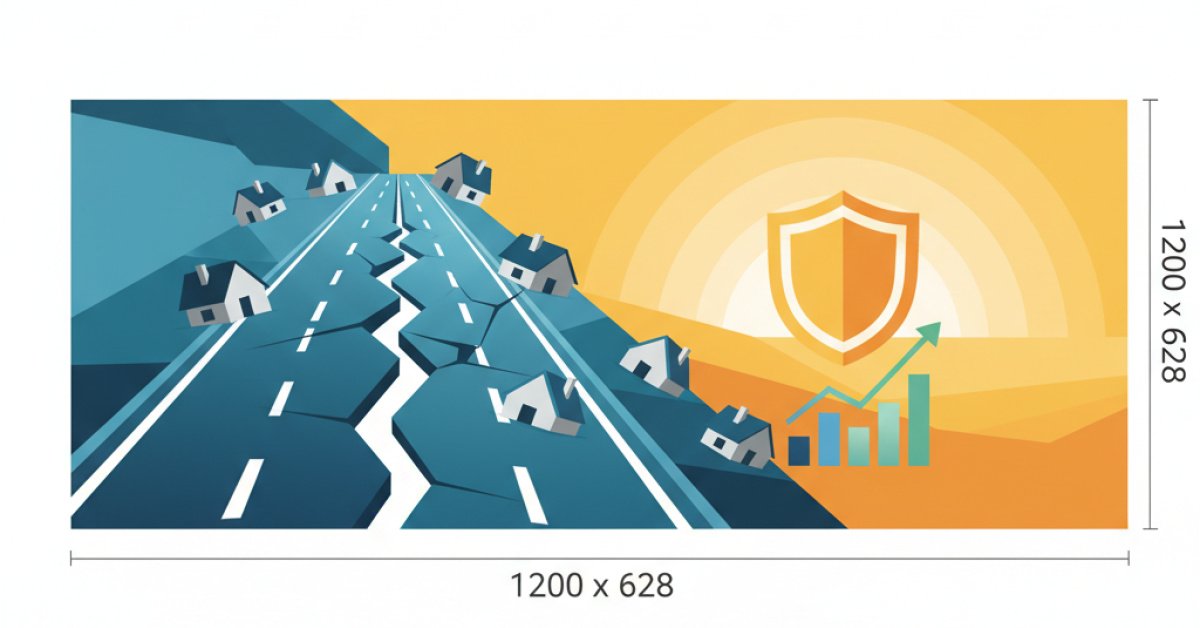
It was the day after Thanksgiving. Most of us were probably dealing with a turkey hangover or scrolling through Black Friday deals. But in Anchorage, Alaska, the world literally started to come apart at the seams. A massive 7.0 magnitude earthquake ripped through the region, a violent shake that wasn't just a little rumble—it was the kind of event that cracks highways in half and turns homes into a chaotic mess of shattered glass and toppled furniture.
The videos and pictures were stunning. You saw roads that looked like they’d been peeled back by a giant can opener. But as the dust settled, a different kind of tremor began to emerge. This one wasn't geological; it was financial.
As an insurance writer, my first thought wasn't just about the physical damage. It was about the aftermath. And the big, scary secret about the Alaska quake is this: the vast majority of people who felt their homes shake and saw their belongings destroyed were on their own. They had no insurance to cover it.
This is the real aftershock, and it’s a story that should make every single one of us pause and take a look at our own policies.
Why Were So Many People Uninsured?
It seems crazy, right? Alaska is literally called the "shake zone." It has more earthquakes than any other state in the U.S. So why on earth would so few people have earthquake insurance?
Well, it’s not because people are careless. It really comes down to a tough financial calculation.
Here's the thing about earthquake insurance: it’s not part of your standard homeowners policy. Not even close. It’s a separate, extra policy you have to buy, and frankly, it can be incredibly expensive. We’re talking about premiums that can easily add hundreds or even thousands of dollars to your annual insurance bill.
But the high price tag is only half of the problem. The other, and arguably bigger, issue is the deductible.
Let's Talk About Those Deductibles
When you have a car accident, you might have a $500 or $1,000 deductible. You pay that amount, and the insurance company handles the rest. It’s manageable.
Earthquake insurance is a completely different beast.
The deductibles aren't a flat dollar amount. Instead, they are a percentage of your home’s insured value. And they are high. We're talking anywhere from 10% to 25%.
Let me break down what that actually means. Let’s say your home is insured for $400,000. If you have an earthquake policy with a 20% deductible, you are on the hook for the first $80,000 of repairs.
Think about that for a second. Your home could sustain $70,000 in damage—cracked foundation, broken walls, a complete mess—and you would get exactly zero dollars from your insurance company. You’d have to pay for all of it out of pocket.
For most people, that’s an impossible number. So they look at the high premium and the astronomical deductible and make a difficult choice. They gamble that they’ll never need it, or that if a quake does hit, it will be so catastrophic that it blows past that deductible and their policy actually kicks in. It's a bet against disaster, and in this case, a lot of people lost.
The Insurance Companies Are Rattled, Too
You might think that insurers would be relieved that they don't have to pay out a flood of claims. And on one level, they are. But on another, an event like this is deeply unsettling for the industry.
For one, it’s a massive wake-up call. The U.S. Geological Survey (USGS) was quick to warn that the risk of powerful aftershocks was elevated. That means the danger wasn't over. One big quake can destabilize the whole region, leading to more damage in the days and weeks to follow. Insurers have to model for this ongoing risk, and it makes them nervous.
But there’s a bigger picture here. This quake, while serious, wasn't "The Big One" that seismologists have been warning about for years. It was a major event, but it could have been so much worse.
It serves as a real-world stress test, and what it revealed is a population that is frighteningly unprepared for a truly catastrophic event. If this quake caused this much uninsured disruption, what would happen in a 8.0 or 9.0 magnitude event? The economic fallout would be devastating, not just for individuals, but for the entire state. Insurers know this, and it’s a scenario that keeps them up at night.
What Can We Learn From This?
It’s easy to look at what happened in Alaska and think, "Wow, that's tough for them." But the real lesson here is that this isn't just an Alaska problem.
Whether you live in California, the New Madrid Seismic Zone in the Midwest, or even in places like Oklahoma where fracking has increased seismic activity, this is relevant to you. The core issue is universal: are you truly prepared for the specific disasters that could strike your area?
Most of us assume our homeowners insurance is a magic blanket that covers everything. It’s not. It has very specific exclusions.
- Earthquakes? Almost never covered.
- Floods? Nope, that’s a separate policy, too.
- Sewer backups? Usually requires a special add-on.
The Alaska quake is a stark, powerful reminder to stop assuming and start asking questions. Pull out your policy—yes, I know it's boring—and read what it actually says. Better yet, call your agent and have a real conversation. Ask them directly: "What am I not covered for?"
You might not like the answers. You might find out that, like those homeowners in Anchorage, you're more exposed than you thought. But knowing is the first step. It allows you to make an informed choice, whether that’s buying the extra coverage, building up your emergency savings, or simply understanding the risk you’re choosing to accept.
Don't wait for the ground to start shaking to find out what's in your policy. That’s a lesson we can all take from our neighbors in Alaska.