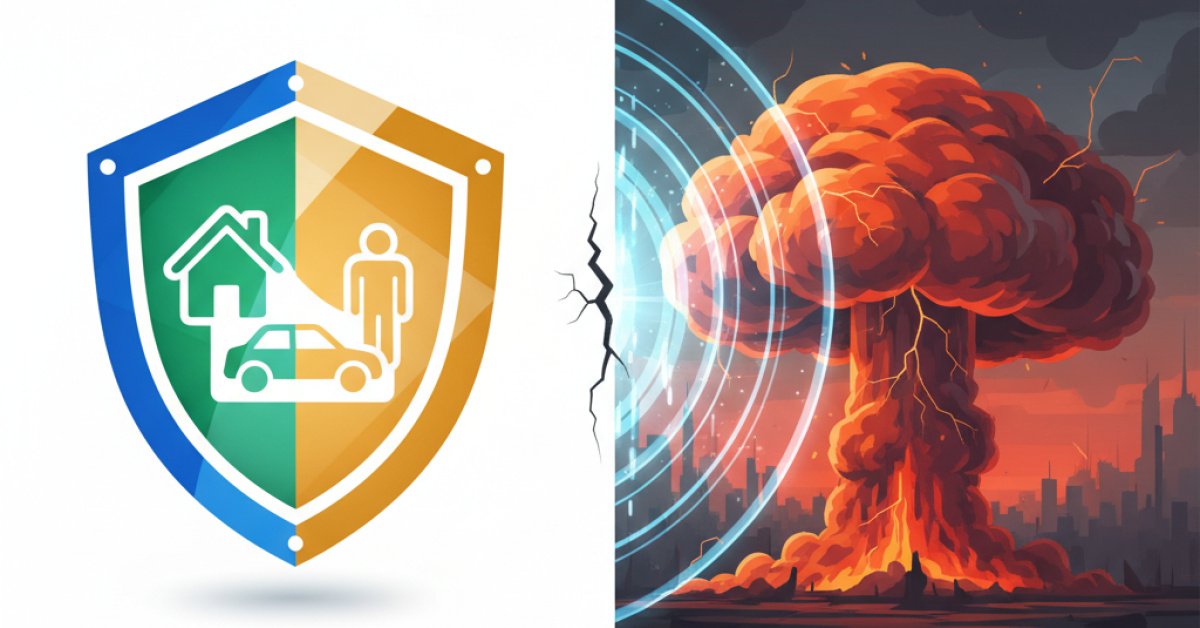
Let’s have a frank conversation about something that’s probably not on your daily worry list, but maybe it should be. We talk a lot in the insurance world about fires, floods, and car accidents. But what about the really big one? The unthinkable one.
Every so often, you’ll see a headline that makes your stomach clench. A world leader mentions resuming nuclear testing, and suddenly, those old black-and-white "duck and cover" videos don't seem so funny anymore. It brings back a kind of Cold War anxiety most of us thought we'd left behind.
As an insurance person, my brain immediately goes to a different place. Not just to the geopolitical side of things, but to the practical, financial, and societal fallout. And it leads to a question I get asked in hushed tones: "Would my insurance cover... you know... that?"
The short answer is no. Absolutely not. And the reason why tells you everything you need to know about how insurance actually works, and where its power ends.
First, Let's Talk About How Insurance is Supposed to Work
Think of insurance as a big, shared safety net. We all chip in a little bit of money (our premiums) into a giant pool. Most of us, thankfully, will go about our year without a major disaster. Our houses won't burn down, and we won't crash our cars.
But for the few people who do have a terrible day, that giant pool of money is there to help them rebuild.
The whole system is built on a few key ideas:
- The risk is spread out: A house fire in Ohio is paid for by premiums from people in California, Texas, and Maine.
- The events are independent: Your car accident in Florida has absolutely no effect on my house fire in Chicago.
- The losses are predictable (on a large scale): Insurers can use decades of data to predict, with surprising accuracy, how many house fires or car accidents will happen in a given year. They don't know whose house will burn, but they know roughly how many will.
This is how a company can take your $1,000 premium and promise to give you $300,000 if your house is destroyed. They’re betting that you’ll be one of the lucky ones, and that bet is backed by a whole lot of math.
So, Why Does a Nuclear Bomb Break the Entire System?
A nuclear event isn’t just a bigger, scarier version of a house fire. It's a completely different category of event that shatters every single principle insurance is built on.
Imagine a nuclear weapon detonating over a major city. What happens next?
It’s not one house burning down. It’s every house, every business, every car, and every road for miles in every direction being instantly obliterated. The losses aren't independent; they are perfectly correlated. Everyone in the blast radius loses everything, all at the same time.
There’s no pool of money big enough to handle that. You can't spread the risk because the risk is concentrated in one catastrophic moment. The very people and infrastructure needed to assess damage, process claims, and write checks—the insurance companies, the banks, the government—would likely be gone, too.
The math simply ceases to exist. How do you calculate a premium for an event that would end the economy as we know it? You can't. It's not a risk; it's a certainty of total, systemic collapse.
The "War Exclusion" Clause: Your Policy's Fine Print
If you’re brave enough, go pull out your homeowner's or business insurance policy. Dig through the pages of exclusions (the part that lists everything they won't cover). I can pretty much guarantee you’ll find it.
It’s usually called a "War Exclusion" or a "Nuclear Hazard Exclusion" clause.
This isn't some new thing, either. These clauses have been standard in insurance policies for over 70 years, ever since the dawn of the atomic age. They explicitly state that the policy will not pay for losses resulting from:
- War (whether declared or not)
- Insurrection or rebellion
- Nuclear reaction, radiation, or radioactive contamination
It’s not because insurers are heartless. It's because they are realists. They know that covering such an event is a promise they could never, ever keep. To sell a policy that pretends to cover a nuclear attack would be dishonest. The financial devastation would be so absolute that the insurance company itself would cease to exist, along with everything else.
What about a smaller-scale event?
You might be thinking, "Okay, a full-blown nuclear war is one thing. But what about a terrorist 'dirty bomb' or an accident at a nuclear power plant?"
Unfortunately, the exclusions are written to be incredibly broad for this very reason. The wording "nuclear reaction, radiation, or radioactive contamination" is designed to cover almost any scenario you can think of.
The problem is the same, just on a slightly different scale. The contamination from a major nuclear accident could make hundreds of square miles of land uninhabitable for decades. How do you put a price on that? How do you clean it up? The costs are astronomical and the timeline is indefinite. Again, it’s a risk that private industry simply cannot absorb.
If Insurance Can't Help, Who Does?
This is where we have to face a sobering reality. For risks of this magnitude, the responsibility shifts from private companies to national governments and international bodies.
Events like nuclear war, pandemics, and total economic collapse are what we call "systemic risks." They threaten the entire system, not just individual parts of it. The only entity with the resources (and the responsibility) to manage and respond to a crisis of that scale is the government.
Even then, let's be honest. In the aftermath of a nuclear event, the focus wouldn't be on processing insurance claims. It would be on survival, medical care, and restoring the most basic functions of society. The concept of financial compensation becomes almost meaningless when the entire financial system has been vaporized.
It's a stark reminder that while insurance is a powerful tool for managing life’s predictable uncertainties, some things are just too big, too devastating, and too all-encompassing. They defy the math, they break the models, and they fall outside the realm of what we can reasonably plan for.
And that, frankly, is a risk we all just have to live with.