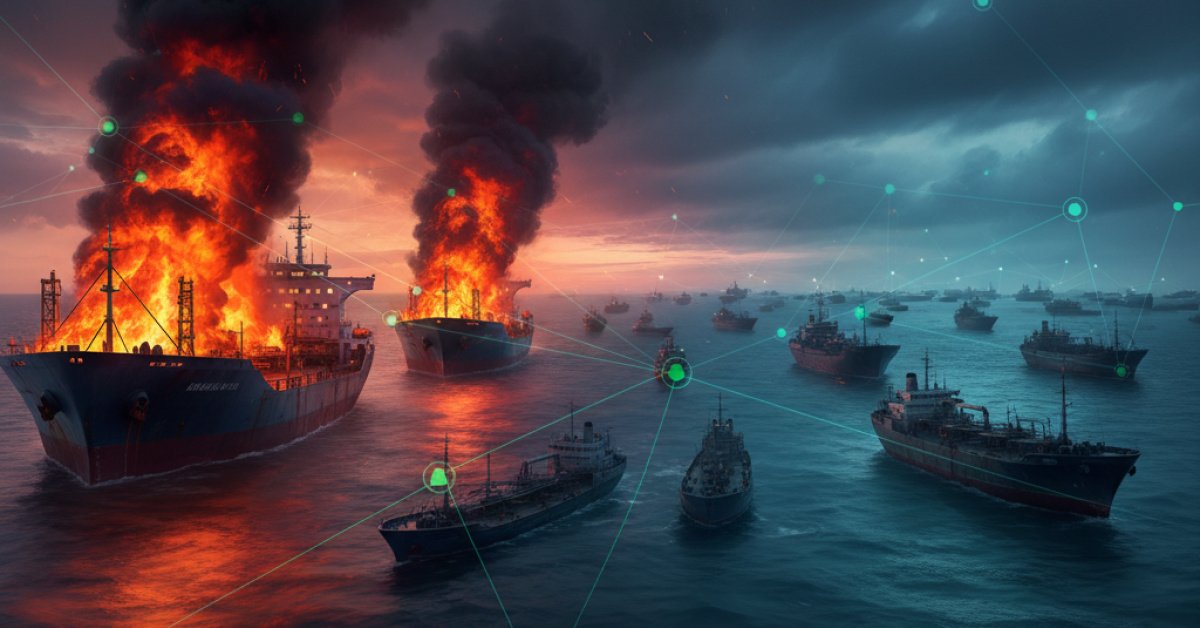
You know that feeling when you get a news alert on your phone, and your stomach just drops? That’s what happened across the marine insurance world recently. The headline was stark: two oil tankers, ablaze, after some kind of "external impact."
My first thought wasn't just about the crews or the cargo. It was, "Here we go again." Because for those of us who live and breathe maritime risk, an incident like this is never just about two ships. It's a symptom of a much bigger, much murkier problem that's been keeping underwriters up at night.
We're talking about the "shadow fleet." And if that term sounds like something out of a spy novel, well, the reality isn't far off. Let's get into what really happened and why it’s a massive red flag for anyone involved in insuring the things that move across our oceans.
So, What Exactly Went Down?
First, let's paint the picture. We have two tankers, both reportedly hit by something that caused significant fires. The details are still hazy, but "external impact" is code for "this wasn't an accident." We're likely talking about a drone, a missile, or some other form of attack in a geopolitically sensitive shipping lane.
This immediately puts everyone on edge. It’s a stark reminder that certain parts of the world are incredibly high-risk. But the real kicker, the detail that changes the entire conversation, is the suspected link to the shadow fleet.
It seems at least one of the vessels involved was part of this clandestine network of ships. And that, my friends, is where a bad situation turns into a potential catastrophe for the insurance industry.
The Real Elephant in the Room: The "Shadow Fleet"
Okay, so what is this shadow fleet everyone's talking about?
Think of it like this: You have the regular world of shipping, where vessels are properly registered, maintained to international standards, and insured by reputable P&I clubs and carriers. It’s a regulated system. It's not perfect, but there are rules.
Then you have the shadow fleet. This is a massive, growing armada of aging tankers operating completely outside that system. They're often owned by anonymous shell companies, they fly "flags of convenience" from countries with lax oversight, and they turn off their tracking systems to go "dark" for days at a time.
Why do they exist? In a word: sanctions. They were created to secretly move oil for countries like Iran, Venezuela, and now, most significantly, Russia. They are the getaway cars of the global oil trade.
Why This Is a Ticking Time Bomb for Insurers
Imagine you're driving down the highway, following all the rules. You're in a well-maintained car, and you have great insurance. Suddenly, you're hit by a beat-up clunker with no license plates, no registration, and an uninsured driver who flees the scene.
That’s the shadow fleet. They are sharing the world's busiest shipping lanes with legitimate, well-insured vessels, and they are accidents waiting to happen.
Here’s why they give risk managers nightmares:
- Questionable Seaworthiness: These are often old, poorly maintained ships that would never pass a proper inspection. The risk of mechanical failure, groundings, or spills is astronomically high.
- Mysterious Insurance: They claim to have insurance, but it's usually from unknown, untested providers in countries with no real capital to back up a major claim. If one of these causes a billion-dollar oil spill, who pays? You can bet the legitimate industry will be left holding the bag.
- Inexperienced Crews: The crews are often underpaid and undertrained, increasing the risk of human error.
When a shadow fleet tanker has a casualty, it creates a black hole of liability. There's no reputable insurer to call. There's no transparent owner to hold accountable. It’s a mess.
How This Puts Carriers and Risk Managers on High Alert
So, back to our two burning tankers. If one of them is part of the shadow fleet, the implications are huge. It's not just a loss for whatever shady insurer is covering it; it's a massive escalation of risk for the entire maritime world.
For marine underwriters and risk managers, this changes the game.
First, underwriting gets a lot harder. How do you price risk in the Red Sea or other hotspots when you have hundreds of these ghost ships sailing around? You can't just assess the vessel you're insuring; you have to account for the uninsured clunker that might crash into it. This uncertainty is a killer for accurate pricing.
Second, the risk of collateral damage skyrockets. What if one of these tankers collides with a modern, fully-insured container ship? Or what if it causes a catastrophic spill that closes a major port like Singapore or the Suez Canal? The ripple effects and the resulting claims would be devastating, and the legitimate insurance market would be on the hook for a huge portion of it.
Third, War Risk premiums are going to react. Whenever there's an attack like this, the Joint War Committee in London reassesses the risk level of that specific area. That means any legitimate shipowner wanting to transit through the region is going to see their insurance costs spike. This incident pours gasoline on an already smoldering fire of geopolitical risk.
What Can We Even Do About It?
It’s a tough spot to be in, and honestly, there are no easy answers. But for those of us on the front lines of managing this risk, it comes down to being more vigilant than ever.
We're seeing a huge push for enhanced due diligence. You can't just take shipping documents at face value anymore. You have to dig deep: Who really owns this vessel? Where has it been for the last 12 months? Is its insurance policy worth the paper it's printed on?
Technology is helping. We're using sophisticated tracking services that can flag suspicious behavior, like a ship turning off its transponder near a sanctioned port or engaging in a ship-to-ship transfer in the middle of the ocean. It’s a high-tech game of cat-and-mouse.
But ultimately, this is a problem that goes beyond what the insurance industry can solve alone. It requires a coordinated effort from governments and international maritime bodies to crack down on this shadow economy.
This latest incident isn't a wakeup call—the alarm has been ringing for a while. It’s more like a fire alarm that’s been pulled in the middle of the night. It’s loud, it’s urgent, and it confirms that the danger we've all been warning about is very, very real. For now, all we can do is double-check our own exposures, advise our clients to be incredibly careful, and brace for more turbulence ahead. The waters are only getting rougher.