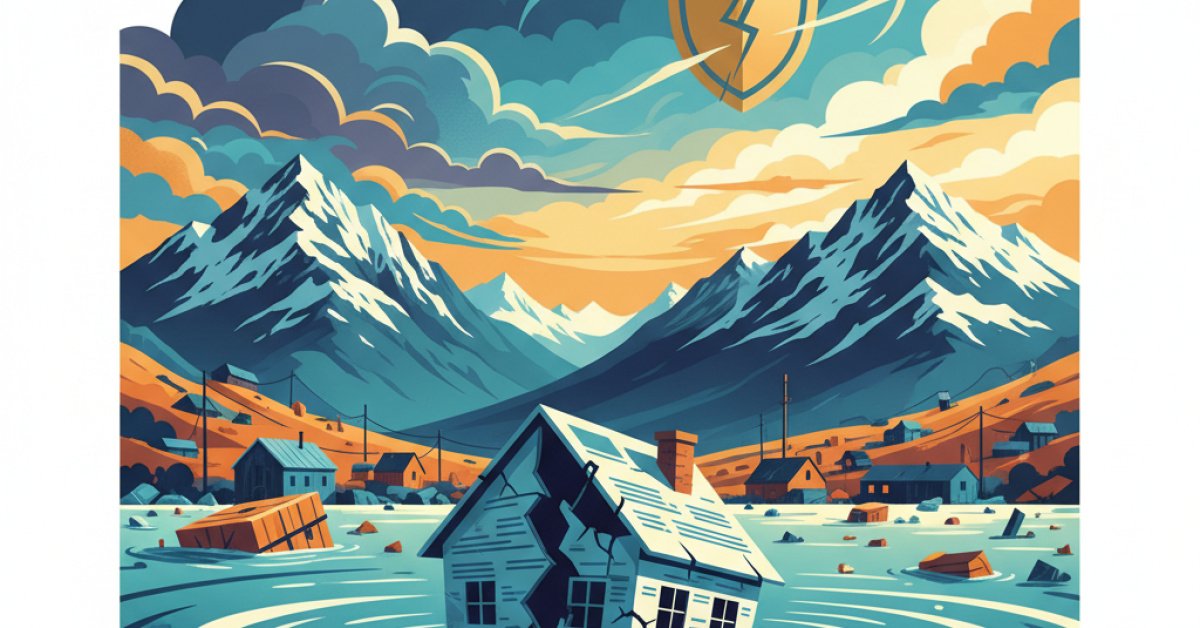
It’s a scene that’s hard to wrap your head around. Imagine watching your neighbors, your friends, your family, all being airlifted out of your home village. The only home you’ve ever known.
You stay behind, one of just a handful of people left, walking on debris-strewn boardwalks over land that’s still more water than earth. This was the reality for people like Darrel John in western Alaska after a massive storm surge and flooding literally washed away their communities.
When you see images like that, the first thing you feel is a deep sense of empathy for the people whose lives have been turned upside down. But as someone who lives and breathes insurance, my mind also jumps to the next, incredibly difficult question: How do you even begin to put this back together?
Because when the news crews leave and the water finally recedes, the long, grueling, and often confusing financial recovery begins. And that’s where insurance—or the lack of it—takes center stage.
The First Shock: Realizing Your Homeowners Policy Isn't a Lifeline
Let's get one of the most painful and common misunderstandings out of the way right now. When it comes to a flood, your standard homeowners insurance policy is, unfortunately, not going to help.
I can't tell you how many times I've had to explain this to people in the middle of a crisis. It's heartbreaking. People pay their premiums diligently for years, thinking they're covered for any disaster. But if you read the fine print, virtually every standard home policy has a very clear exclusion for damage from flooding—meaning rising water from the outside.
Why? Think of it from the insurer's perspective. Flood risk is concentrated in specific areas. If they included it in every policy, people in low-risk areas (say, on a mountain in Arizona) would be paying for the risk of people in high-risk areas (like a coastal village in Alaska or a home near the Mississippi River). The system just wouldn't work.
So, for flood coverage, you need a separate policy. For most people in the U.S., that means turning to the National Flood Insurance Program, or NFIP. It’s a federal program specifically designed to fill this critical gap. But here's the catch: you have to know you need it, and you have to sign up for it before the disaster strikes.
The Tyranny of Distance: When Getting Help is a Nightmare
Now, let's talk about what makes a situation like the one in Alaska so uniquely challenging. It's one thing to deal with a flood in a suburb of Houston. It’s a completely different universe when your village is only accessible by small plane or boat.
Imagine you're an insurance adjuster. Your job is to get to the damaged property, assess the losses, and start the claims process. In a typical disaster, you'd drive to the neighborhood, maybe deal with some road closures, but you'd get there.
But in western Alaska?
- Getting there is a huge ordeal. You’re flying in on a tiny plane, weather permitting. There are no rental cars waiting for you. There are no hotels.
- Assessing the damage is complex. We’re not talking about standard drywall and 2x4 construction. These are unique homes, often built on stilts or boardwalks over permafrost. How do you value that? How do you know what it will cost to rebuild it in a place where every single nail and piece of lumber has to be flown or barged in at incredible expense?
- The scale is overwhelming. One or two adjusters might be trying to handle claims for an entire community where nearly every structure has been impacted. It’s a logistical and emotional pressure cooker.
This isn't just an inconvenience; it dramatically slows down the entire recovery process. People who have lost everything are stuck in a holding pattern, waiting for an expert to navigate a treacherous landscape just to tell them what their policy will cover.
The Painful Gap Between a Policy and a Paycheck
Even for the residents who had the foresight to get an NFIP policy, there’s often another hard reality waiting for them: being underinsured.
Flood insurance policies have limits. And in a place where construction costs are astronomical due to logistics, the maximum policy payout might not be enough to rebuild the exact same home. It's a brutal calculation. You might get a check, but it won’t be enough to make you whole.
And what about those who didn't have a flood policy?
This is where things get truly dire. Their primary option is often federal disaster assistance, like aid from FEMA. And here’s another critical distinction we all need to understand: FEMA is not insurance.
Think of it this way:
- Insurance is designed to restore your property. It’s a contract. You paid your premiums, and the insurer pays to rebuild or repair, up to your policy limits.
- FEMA aid is a safety net to help you survive. It often comes in the form of small grants for immediate needs (like temporary housing) or, more commonly, low-interest loans that have to be paid back.
A FEMA loan can be a lifesaver, but it’s also a new debt you’re taking on right after losing everything. It’s not a check to rebuild your old life, free and clear. It’s a lifeline that comes with long-term financial obligations.
So, What Does the Road Ahead Look Like?
For these Alaskan villages, the path forward is measured in months and years, not days and weeks. The claims process itself will be a marathon. It will require immense patience and meticulous documentation from residents who are already exhausted and traumatized.
They’ll need to list every single thing they lost, find proof of ownership, and go back and forth with adjusters. It’s a full-time job that nobody ever asks for.
This story, as remote as it may seem, is a powerful reminder for all of us. Disasters, especially floods, are becoming more frequent and more severe everywhere. The lessons from these tiny villages on the edge of the world are universal.
Take a few minutes this week to pull out your own insurance policies. Understand what they actually cover. If you live anywhere where it can rain, you have a risk of flooding. Ask an agent about flood insurance. Find out what it would cost. It might be less than you think, and it could be the one thing that separates a difficult recovery from a financially impossible one.
What’s happening in Alaska is a tragedy, but it’s also a lesson. And it’s one we owe it to them, and to ourselves, to learn.