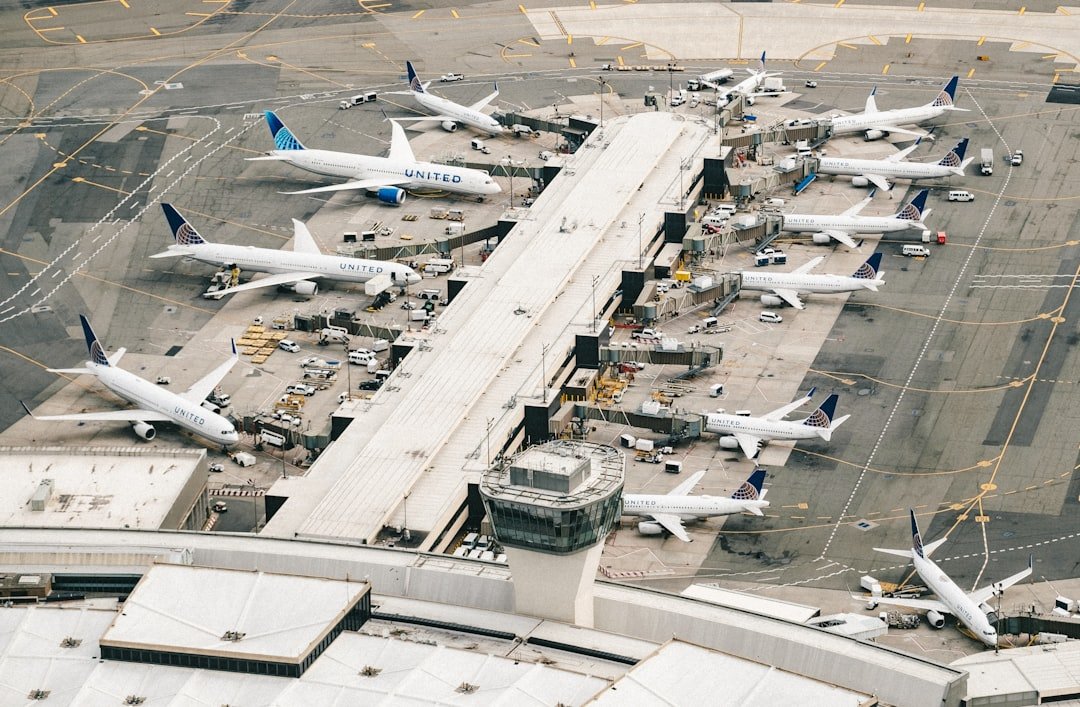
You see it on the news, and it’s a scenario that just feels wrong: a plane colliding with a vehicle on the ground at an airport. It’s supposed to be the safest part of the journey. When a tragedy like the collision between an Air Canada Express plane and a fire truck happened at LaGuardia, the first questions are always about the victims and their families.
But as an insurance person, my mind immediately goes to the next question, the one that unfolds over months and years in courtrooms and conference rooms: Who is responsible for this? And more specifically, when the incident involves air traffic controllers or federal operations, can you actually hold the U.S. government liable?
It’s a question that seems simple on the surface, but let me tell you, it’s one of the most complex puzzles in the world of liability and insurance. Let's break it down.
The Big Hurdle: You Can't Just Sue the Government
Here’s the thing. Your first instinct might be to sue everyone in sight, and that often includes Uncle Sam. But there’s a huge, centuries-old legal wall called "sovereign immunity."
Think of it like this: back in the day, the king could do no wrong. You couldn’t drag the Crown into court just because your cart hit a pothole on the king's road. That basic principle carried over into U.S. law. For a long, long time, you simply were not allowed to sue the federal government, period.
Obviously, that’s not entirely fair in a modern world where the government is involved in everything from delivering mail to managing our skies. So, Congress created a special key to unlock that door, but only in very specific circumstances.
The Key to the Courthouse Door: The Federal Tort Claims Act (FTCA)
This key is a law called the Federal Tort Claims Act, or FTCA. In simple terms, the FTCA is the government waving a small white flag and saying, "Okay, if one of our employees, acting in their official role, messes up and hurts you through their negligence, you can hold us accountable."
Sounds great, right? A clear path to justice! Well, not so fast. The FTCA is loaded with exceptions and trap doors. It's less of a wide-open gate and more of a narrow, tricky path.
The biggest exception, and the one that’s a real headache in cases like this, is something called the "discretionary function" exception.
What on Earth is a "Discretionary Function"?
This is where things get a bit murky. The government says you can sue for negligence (an employee messing up a task), but you can't sue over a policy decision (the government deciding how to do things).
Let me give you a simple analogy. Imagine the government decides to design a new type of guardrail for highways. That’s a policy choice based on engineering, budgets, and safety studies. If you get in an accident and argue the guardrail design was flawed, you probably can't sue. That was a discretionary decision.
But, if a federal employee improperly installs that guardrail, leaving bolts loose, and you crash as a result? That’s negligence. That’s the kind of thing the FTCA was designed to cover.
In an airport collision, the question would be: Was the accident caused by an air traffic controller making a specific, negligent mistake? Or was it the result of a broader FAA policy on runway management that someone is trying to challenge? The former might be a valid claim; the latter will almost certainly get thrown out of court.
Untangling the LaGuardia Collision: Who's on the Hook?
So, let's apply this to the situation at LaGuardia. To figure out who could be liable, you have to look at every single person and entity involved. It’s a messy web.
-
Air Traffic Control (ATC): This is the most direct link to the federal government. Air traffic controllers are employees of the Federal Aviation Administration (FAA). If an investigation shows an ATC error—like clearing the plane for takeoff while the fire truck was on the runway—that could be a clear case of negligence. This is exactly what the FTCA is for.
-
The Airport Operator: Here's a curveball. LaGuardia isn't run directly by the federal government. It's operated by the Port Authority of New York and New Jersey. This is a bi-state agency, not a federal one. So, if the fire truck was operated by the Port Authority, and its driver was at fault, any lawsuit would be against them, governed by state laws, not the FTCA.
-
The Airline: Air Canada has a massive responsibility to its passengers and crew. They are what's known as a "common carrier," which means they are held to the highest standard of care. Their pilots, their procedures, and their maintenance will all be under a microscope.
-
The Fire Truck Operator: Who was driving that truck? Were they a Port Authority employee? A contractor? Their actions and training are a critical piece of the puzzle.
Investigators from the National Transportation Safety Board (NTSB) will spend thousands of hours creating a minute-by-minute account of what happened. Their findings will essentially draw a roadmap for the lawyers to follow.
Following the Money: How Insurance Kicks In
An incident like this triggers an avalanche of insurance claims. The numbers are astronomical, and the policies are some of the most complex in the world.
First, you have the airline's insurance. They carry massive liability policies that cover injury and death to passengers and crew, as well as "hull insurance" to cover the value of the destroyed aircraft. We're talking hundreds of millions, or even billions, of dollars in coverage.
Then, the airport operator (the Port Authority) has its own giant liability policy to cover incidents that happen on its property.
But what about the government? Does the FAA have an insurance policy? Nope. The U.S. government is "self-insured." There’s no Allstate or State Farm for Uncle Sam. If you successfully sue the government under the FTCA, your payment comes from a special fund in the U.S. Treasury called the Judgment Fund. It's an open checkbook, but getting it to open for you is the hard part.
The process isn't as simple as filing a lawsuit, either. Before you can even go to court under the FTCA, you first have to file an administrative claim with the specific agency involved (in this case, the FAA). They get a chance to investigate and offer a settlement. Only after they deny your claim, or ignore it for six months, can your lawyer file a lawsuit in federal court.
It's a long, draining, and incredibly expensive process. The legal teams for airlines, airports, and the government are some of the best in the world. They will fight every single point, because the stakes are just so high.
Ultimately, a tragic event on a runway is a powerful reminder of the invisible systems that surround us. We see a plane and a fire truck, but behind them lies a dizzying network of legal duties, government regulations, and incredibly complex insurance contracts. Figuring out who pays is never simple, and when the government is involved, you're not just filing a claim—you're challenging a system designed, by its very nature, to protect itself.