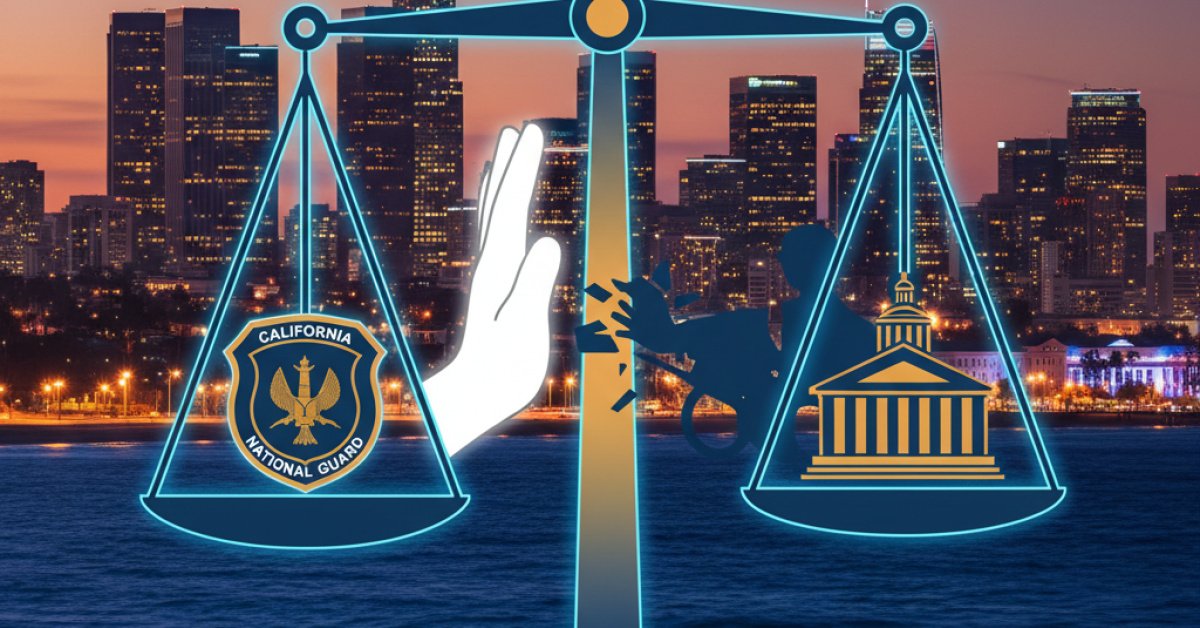
It’s one of those things you never really expect to see in your own city. Military troops on the streets. It’s jarring, and it immediately brings up a ton of questions. Who are they? Who sent them? And maybe the most important one of all: who’s actually in charge here?
For the people of Los Angeles, that last question just got a very clear, and very forceful, answer from a federal courtroom.
In a power struggle that pits the state of California against the White House, a judge has drawn a firm line in the sand. It’s a classic story of state rights versus federal authority, but this one has real-world consequences playing out in real-time. Let's break down what happened and, more importantly, what it means for you.
So, What Exactly Did the Judge Say?
On Wednesday, U.S. District Judge Charles Breyer in San Francisco didn't mince words. He issued what’s being called an "emphatic ruling" directly aimed at the Trump administration.
The order was simple and direct:
- You must stop deploying the California National Guard in Los Angeles.
- You must return control of those troops back to the state of California.
Think about that for a second. A federal judge has essentially told the President of the United States, "You've overstepped." This wasn't a suggestion or a recommendation; it was a legally binding order. Judge Breyer’s decision sided squarely with California, reinforcing the governor's authority over the state's own guard for state-level matters.
The Tug-of-War Over the Guard
This whole situation can get a little confusing, I get it. Isn't the National Guard part of the U.S. military? Well, yes and no. It’s complicated.
Imagine the National Guard is like a highly skilled employee who works for a local branch of a huge corporation. Most of the time, they report to the local branch manager (the state governor). They handle local issues, like responding to earthquakes, floods, or civil disturbances.
But, the CEO of the whole corporation (the U.S. President) can "federalize" that employee and call them up to work on a national project, like a war overseas.
The conflict in Los Angeles boiled down to this: the White House was trying to direct that "local employee" without officially calling them up to corporate. The administration was asserting a level of control that, according to California and now Judge Breyer, it simply didn't have in this situation. The state argued that unless the Guard is officially federalized, the governor is the commander-in-chief.
Why This Ruling Is a Really Big Deal
Okay, so why should you care about a legal squabble in a San Francisco courtroom? Because this is about more than just Los Angeles or the National Guard. This is a fundamental check on presidential power.
Our country was set up as a balance between the federal government and individual states. This ruling is a powerful reminder of that structure. It says that the president can't just decide to use a state's resources—in this case, its citizen-soldiers—without following the proper legal channels.
It sets a powerful precedent. Governors in other states who might find themselves in a similar standoff with the federal government now have a strong legal ruling to point to. It clarifies the chain of command and pushes back against the idea of a limitless executive authority, which is a cornerstone of how our government is designed to work.
What Happens Now?
This is almost certainly not the end of the story. You can bet the Trump administration's lawyers are already working on an appeal. Legal battles of this magnitude rarely end with the first ruling.
But for right now, the impact is immediate. Control of the California National Guard troops in Los Angeles is back in the hands of the state. It means the decisions about what those troops do, where they go, and when they go home will be made in Sacramento, not Washington D.C.
Ultimately, this story is a fascinating, real-world civics lesson. It’s a reminder that even in the most heated and tense moments, there’s a system of rules and checks and balances at play. And sometimes, it takes a judge in a courtroom to blow the whistle and make sure everyone is playing by them.