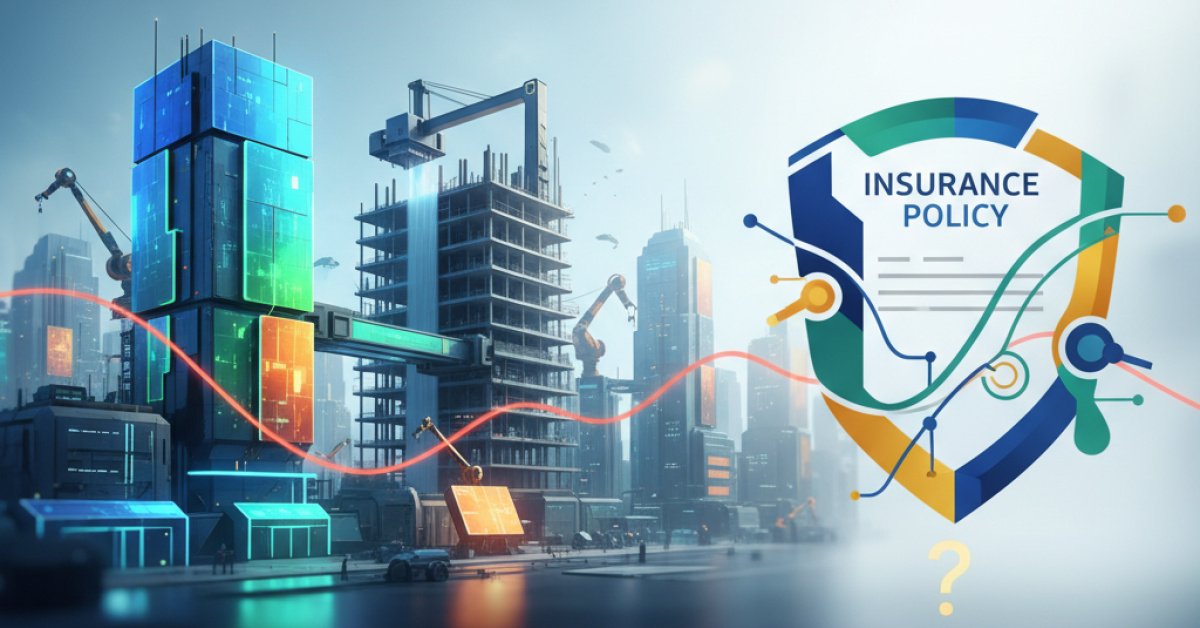
Let’s be honest, it’s an exciting time to be in construction. We're seeing innovations that feel like they’re straight out of science fiction. We’re talking about modular buildings that snap together like LEGOs, massive structures 3D-printed from concrete, and beautiful high-rises built with engineered wood.
These new methods promise to be faster, cheaper, and often greener than the old ways of doing things. For a developer, it sounds like a dream come true. You get your project done under budget and ahead of schedule. What’s not to love?
Well, there’s a catch. A big one. It often shows up right when you’re about to break ground, in the form of an eye-watering insurance premium. Suddenly, a good chunk of the money you saved on materials and labor is being eaten up by your insurance costs. It’s a frustrating moment, and it’s happening on projects all over the country.
So, what gives? Why is the insurance industry, a partner you absolutely need, suddenly acting like a roadblock to progress?
Why Are Insurers So Wary of New Building Techniques?
To understand this, you have to get inside an underwriter's head. Insurance, at its core, is a business built on history. It runs on decades, sometimes centuries, of data about what can go wrong.
Think of it like this: Insurers know exactly how a traditional wood-frame building behaves in a fire. They have mountains of data on how a steel-and-concrete structure holds up in an earthquake. They know the average cost to repair water damage in a standard drywall-and-joist building. This historical data allows them to predict risk with a pretty high degree of accuracy and set a price (your premium) that reflects that risk.
Now, you come to them with a 10-story building made of cross-laminated timber (CLT). It’s amazing, it’s strong, it’s sustainable. But the insurer’s first thought isn’t about the architecture. It's a series of questions:
- How does this really perform over 50 years? We have lab tests, sure, but not decades of real-world wear and tear.
- What happens if a small fire breaks out? We know it's fire-resistant, but what about smoke damage or charring? How do you repair a giant, custom-milled wood panel versus just replacing a few 2x4s?
- What about water damage? How does moisture affect these massive laminated panels over time? Could rot or delamination become a hidden, catastrophic problem?
It’s not just mass timber. Every new method comes with its own set of scary unknowns for an insurer.
Modular and Prefab Construction
On the surface, building sections in a factory seems safer. It's a controlled environment, away from the rain and wind. But it introduces new risks they haven't fully priced yet.
How are those massive modules being transported to the site? A fender bender on the highway could damage a critical structural component. And what happens during the "stitching" process on-site? If the seals between modules aren't perfect, you could be looking at a nightmare of hidden leaks and water damage down the road. Fixing a problem inside a sealed wall between two modules is a whole different (and more expensive) beast.
3D-Printed Structures
This one is maybe the most futuristic, and for an insurer, the most frightening. The questions are endless. What's the long-term structural integrity of layered concrete? How does it handle the natural shifting and settling of a building over time?
And the biggest one: repairability. If a unique, 3D-printed structural wall cracks, you can't just send someone to Home Depot for a replacement part. The entire process of repairing it is novel, untested, and likely very, very expensive. For an underwriter, "expensive and unpredictable" is a five-alarm fire.
The Bottom Line: Unknowns Drive Up Your Costs
Here's the simple, brutal truth: In the world of insurance, "unknown" equals "risk." And "risk" always, always equals a higher price.
When an underwriter can't pull up 30 years of data on a material or method, they have to assume a worst-case scenario. They're pricing in the possibility of a catastrophic failure, a hugely expensive repair, or years of litigation. That’s why the builder’s risk policy for your innovative project might be double or triple what it would be for a conventional build.
And it doesn't stop when construction is finished. The problem can be even worse for the final building owner trying to get a standard property insurance policy. They could be stuck with sky-high premiums for the life of the building, which can seriously impact the property's overall value and profitability. It's a long-term financial headache that starts with the initial design.
So, Are We Stuck? How Do We Move Forward?
It can feel like we’re at a standstill, with builders trying to push forward and insurers holding everyone back. But it doesn’t have to be that way. The solution isn't to stop innovating. It's to be smarter about how we bridge the gap between the new and the known.
If you’re a developer or builder venturing into these new methods, here’s what you need to do:
-
Bring Your Insurer in Early. Like, Really Early. Don't wait until you have a final set of plans to talk to your broker and underwriter. Bring them into the conversation at the conceptual stage. Treat them like a design partner. The more they understand the "why" and "how" of your project, the more comfortable they'll become. Surprising them at the last minute is a recipe for a panic-priced premium.
-
Come Armed with Data. You can’t give them 50 years of history, but you can give them the next best thing. Provide every piece of information you can get your hands on: material stress tests, fire-rating certifications, independent engineering reports, and detailed quality control plans for the factory and the job site. Your job is to make the "unknown" feel as "known" as possible.
-
Focus on the Full Lifecycle. Don't just talk about how you're going to build it. Have a detailed plan for how it will be maintained and repaired. Who is qualified to repair a damaged CLT panel? What's the process for fixing a crack in a 3D-printed wall? Having clear, practical answers to these questions shows the insurer that you’ve thought through the long-term risks, which can give them a lot more confidence.
This is really just a growing pain. The construction industry is taking a giant leap forward, and the insurance industry, by its very nature, is a more cautious follower. They'll get there. The first few projects using any new method are always the hardest to insure. But as we build more of them, as we gather more real-world data on their performance, the risk will become clearer and the premiums will start to come back down to earth.
The key is collaboration. We can't just throw new designs over the wall and expect insurers to blindly sign off. We need to work together, share information, and proactively address their legitimate concerns. If we do that, we can build the future and make sure it's properly protected.