Have you had a chance to look at the new Q1 2026 property report from Verisk yet? On the surface, it looks like some pretty good news. But once you start digging in, you realize the story is a lot more complicated.
It’s one of those classic “good news, bad news” situations we see so often in insurance.
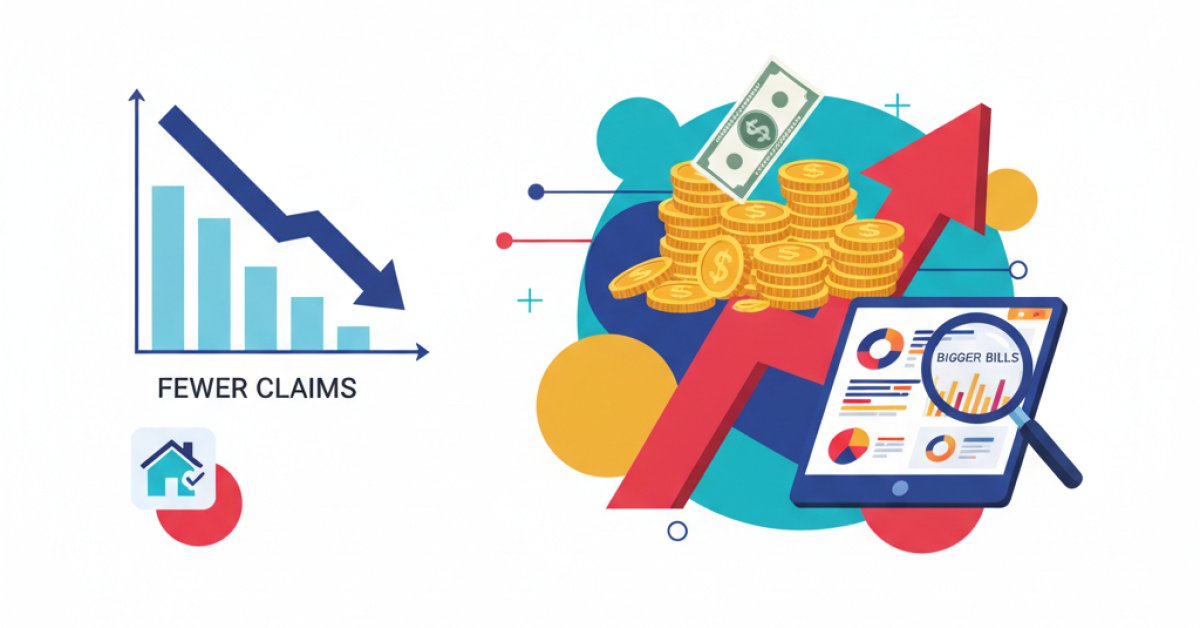
The headline number is that property claim volume actually fell by 8.9% compared to this time last year. It’s even down more than 13% from the five-year average. You’d think that would be cause for a little celebration, right? Fewer claims should mean less pressure. But that’s not what’s happening. The real story, the one that’s going to affect our balance sheets and reserves, is hiding in the cost of each claim.
Let’s break down what’s really going on.
The Big Paradox: Fewer Claims, But a Bigger Bill
Think of it like your grocery shopping. You might be buying fewer items, but if the price of everything you do buy has skyrocketed, your total bill at the checkout is still going to make you wince. That’s exactly what we’re seeing in property claims right now.
While the number of claims is down, the severity—the average cost to close a claim—is telling a much scarier story.
Right now, the average replacement cost value for a claim is sitting at $16,079. That seems okay, maybe even a little low compared to recent years. But here's the thing about claim costs: they take time to fully develop. Verisk applied a “maturation rate” based on recent trends, which basically projects the final, all-in cost.
And that projected number? It’s a whopping $17,687 per claim. If that holds true, it would make Q1 2026 the second-most expensive quarter on record. So, while our phones may be ringing a little less, each call is packing a much bigger financial punch.
A Wild Quarter for Weather
So, what’s behind all this? A big part of the story, as always, is the weather. The first quarter of the year was anything but quiet.
We had two major winter storms, Fern and Hernando, that swept across the eastern U.S. Together, they buried us in over 46,000 claims for ice, snow, and building collapses. The estimated replacement cost for just those two storms is already over $478 million.
Then, in March, a massive wind event tore through the central part of the country. It was no small thing—over two days, more than 1.5 million homes were hit with wind gusts of at least 60 mph. This single event was enough to launch Ohio into the number two spot for claim volume nationwide.
But the most dramatic story comes from Hawaii. It’s not often we see the Aloha State at the top of the catastrophe list, but a March "Kona low" storm system just hammered the island of Oahu. It led to a mind-boggling 1,900% jump in CAT claims compared to last year. We’re talking over 2,000 wind, water, and flood claims totaling around $14 million in damages. Just an unbelievable surge.
Where Are the Claims Coming From?
When you look at the map, a few states are carrying most of the weight.
Texas, Ohio, and California were the top three for claim volume this quarter, accounting for nearly a quarter of all claims in the entire country.
But the state-level data also has some quirks you need to understand. Take Florida, for example. The state saw a massive 65.7% decline in claims and fell 13 spots in the rankings. Why? It’s not because it suddenly became immune to damage. It’s because the first quarter of last year was still swamped with late-reported claims from Hurricane Milton. It’s an echo effect, and it makes the year-over-year comparison look a bit strange.
We see a similar distortion in California. The devastating Palisades and Eaton fires in 2025 skewed the numbers. If you actually pull those fire and smoke claims out of the data to get a clearer picture, the national severity numbers look a bit different. Without them, Q1 2026 severity is about 12% lower than the adjusted 2025 figure. It shows how a couple of huge events can throw off the averages for a long time.
What Kind of Damage Are We Seeing?
No big surprises here, but it's still worth noting.
- Water claims continue to be the biggest single driver, making up over 31% of all claim volume.
- Ice and snow claims shot up by a massive 188.7% thanks to storms Fern and Hernando.
- Interestingly, hail claims actually fell by 23.6%. This lines up with other data showing fewer homes were hit by significant hail this quarter. It’s a small bit of relief in an otherwise costly environment.
The Squeeze is Still On: Costs, Labor, and Fuel
This brings us back to the severity problem. Why is everything so expensive to fix? Even though headline inflation has cooled off, the cost pressures in construction and restoration are definitely still with us.
Total reconstruction costs in the U.S. went up 3.4% over the last year. That’s better than the 5.3% increase we saw the year before, but costs are still climbing, not falling.
When you zoom in on the first quarter, combined labor and material costs rose another 1.21%. Here’s a quick breakdown:
- Labor: Concrete masons saw the biggest annual pay jump, up over 15%. The good news is that the pace seems to be slowing down.
- Materials: Here’s a surprise—lumber is actually getting cheaper. Prices are down over 2% in the U.S. because of an oversupply and softer demand from home builders.
- Fuel: And here’s the big red flag. Fuel costs went completely in the other direction, spiking an incredible 42.7% in the U.S. during the quarter, with most of that happening in March. The report links this directly to the conflict in Iran and shipping disruptions in the Strait of Hormuz.
That fuel spike is the thing to watch. Fuel is what we call a leading indicator for construction costs. It immediately impacts the cost of running equipment and trucking materials. But its effect on the price of the materials themselves and on contractor labor rates usually follows with a bit of a lag.
So, the takeaway here is that even though claim volume gave us a bit of a breather in Q1, the storm of high costs is far from over. The numbers show a clear trend: we're handling fewer claims, but each one is more complex and far more expensive to resolve. It’s a crucial reminder that in our world, the headline number rarely tells the whole story.