Imagine you have top-tier insurance on something incredibly valuable. You pay your premiums on time, every time, trusting that if the worst happens, you're protected. Then, the worst happens. You file your claim, and the response you get is a flat-out "No. Sorry, that's not covered."
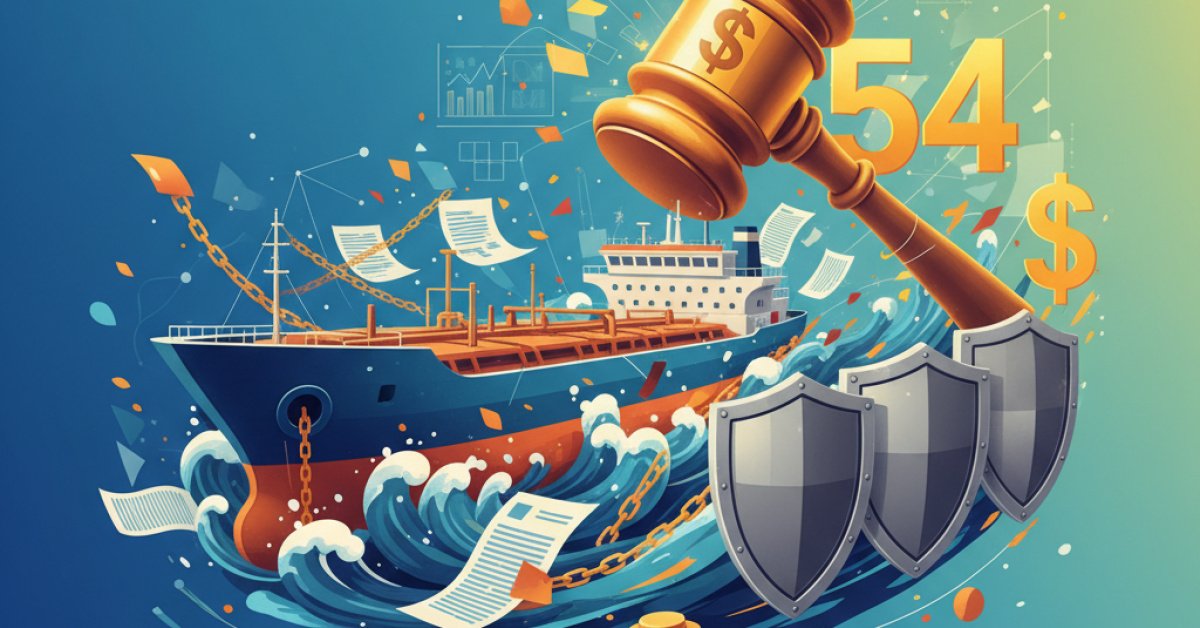
That's a nightmare scenario for anyone, right? Now, imagine that "something valuable" is a massive tanker full of crude oil worth over $50 million, and it's been seized in the middle of a political firestorm.
This isn't a hypothetical. It's exactly what happened to oil giant CITGO, and it kicked off a fascinating, high-stakes legal battle that really gets to the heart of what insurance is all about. This story is a perfect example of how the fine print in a policy can be tested by real-world chaos, and the outcome is a big deal for anyone in the business of insuring risky assets.
So, What Exactly Happened Off the Coast of Venezuela?
Let’s set the scene. The year is 2019, and Venezuela is in the grip of a major political crisis. The country is essentially being torn between two leaders, creating enormous instability. In the middle of all this, CITGO had a deal to buy a huge shipment of crude oil from PDVSA, Venezuela's state-owned oil company.
The oil was loaded onto a tanker, but before it could set sail, the Venezuelan government stepped in. They refused to let the ship leave unless CITGO paid for the oil right then and there. This was a classic power play. The government basically held the cargo hostage.
As you can imagine, CITGO wasn't about to just hand over millions of dollars under those conditions. The ship and its precious cargo were stuck. After months of going nowhere, the Venezuelan government officially seized the oil. For CITGO, the $54 million asset was gone.
This is exactly why companies buy cargo insurance. It’s designed to protect against loss or damage during transit. So, CITGO did what any of us would do: they turned to their insurers to file a claim.
"Sorry, That's Not Covered": The Insurers' Big Argument
Here’s where things get sticky. The group of insurers, led by Aspen American Insurance Co., took one look at the situation in Venezuela and denied the claim.
Their reasoning? They pointed to a very common clause in these types of policies: the "war exclusion."
Think of it like this. Your home insurance might cover you for a fire, but it probably has an exclusion for damage caused by an act of war. The insurers argued that the political chaos in Venezuela—the protests, the power struggle, the government's aggressive actions—amounted to something like a "civil war, revolution, rebellion, or insurrection."
They also pointed to another part of the policy that excluded losses from "capture, seizure, arrest, restraint or detainment." On the surface, it sounds like they had a point, right? The government did seize the cargo.
But it’s never that simple. The insurers were essentially saying that the political environment was the root cause, and their policy wasn't designed to cover losses from that kind of large-scale, government-level instability. They were betting the court would see this as a casualty of a nation in turmoil, not a straightforward commercial loss.
The Judge Steps In: Why CITGO's Policy Held Up
CITGO didn't back down. They took their insurers to court, and this is where the details really start to matter.
The judge in a Houston federal court had to look past the dramatic headlines about Venezuela and focus on the actual policy language. What did the insurance contract really say?
CITGO’s argument was simple: this wasn't an act of war. It was a commercial dispute that got ugly. PDVSA was trying to strong-arm them into changing the payment terms of their contract. The seizure, they argued, was a "wrongful taking," which was covered under a different part of their policy.
And the judge agreed.
The court decided that just because a country is in political turmoil doesn't automatically trigger a war exclusion. The seizure wasn't part of a rebellion or a civil war; it was a targeted action by a state-owned company against a specific business partner. It was, at its core, a commercial act, not a military one. The court saw it for what it was: the government wrongfully taking property it didn't have a right to.
Because of this, the court ruled that the insurers were on the hook for the full $54 million. It was a huge win for CITGO and a major blow to the insurers' defense.
Round Two: The Appeals Court Doubles Down
Of course, with this much money on the line, the insurers weren't going to just walk away. They appealed the decision, sending the case up to the 5th U.S. Circuit Court of Appeals. They were hoping a different set of judges would see things their way.
But it didn't work.
The appeals court looked at all the evidence and came to the exact same conclusion. They affirmed the original ruling, stating that the district court got it right. The judges agreed that the loss of the oil was due to a wrongful taking by the Venezuelan government, not an act of war or insurrection.
This second ruling was a critical final nail in the coffin for the insurers' argument. It solidified the win for CITGO and sent a clear message: you can't just use a "war exclusion" clause as a catch-all for any loss that happens in a politically unstable country. The specific facts of the seizure matter more than the general political climate.
What This Case Means for High-Stakes Insurance
So, why should we care about a legal fight between a bunch of massive corporations? Because this case is a fantastic real-world lesson in how insurance policies actually work—or don't work—when things go sideways.
For companies operating in volatile parts of the world, this is a landmark decision. It shows that their insurance might still protect them even when a government acts unpredictably. It provides a bit of confidence that a "war exclusion" can't be used as an easy way out for insurers unless there's a genuine war-like event directly causing the loss.
For insurers, this is a major wake-up call. They'll likely be re-examining the language in their policies and potentially adjusting their premiums for coverage in high-risk regions. They now know that courts will scrutinize these claims very, very closely.
And for the rest of us, it's a powerful reminder to always understand the fine print. An insurance policy is a contract, and every single word matters. When a crisis hits, you quickly find out just how strong that contract really is. This $54 million battle over a tanker of oil is a perfect illustration of that simple truth.