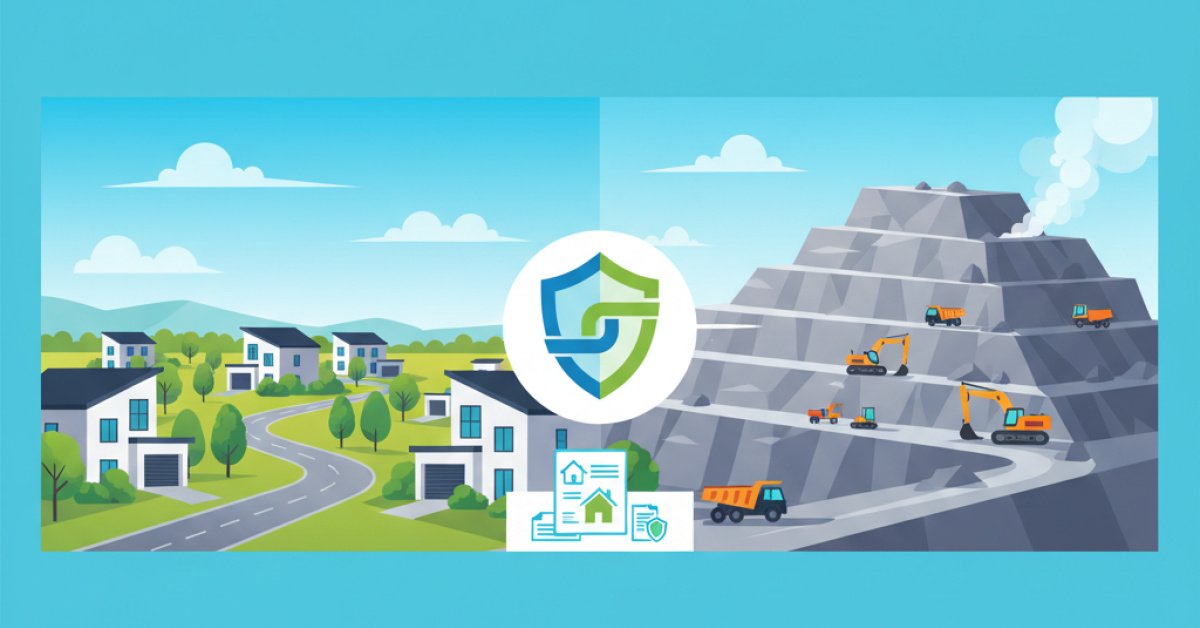
Can you imagine waking up one morning, grabbing your coffee, and finding out a massive limestone mine is planned for your neighborhood? Not in a few years, but soon. And here’s the kicker: you had no say. No one asked you. No one even told you.
That’s not a hypothetical nightmare. It’s exactly what’s happening to residents in Piedmont, South Dakota. A company called Simon Contractors is moving forward with a new mine, and because of what some are calling weak state laws, the plan moved ahead without any requirement for local input or even a simple notification to the people living there.
As you can imagine, people are upset. Three local lawmakers are now scrambling to draft new bills to give communities a voice. But as an insurance writer, this story caught my eye for a different reason. It’s a perfect, real-world example of how a sudden change in your environment can throw a massive wrench into the quiet, predictable world of your personal insurance.
We tend to think of our homeowners policy as a set-it-and-forget-it kind of thing. It’s there for a fire, a tree falling on the roof, or a break-in. But what about the slow-burn risks? The ones that creep in when the world literally changes around your home?
Let's break down what a situation like this really means for your biggest asset and the policy that’s supposed to protect it.
When a New Neighbor Brings New Risks
First, let's be clear about what we're talking about. A limestone mine isn't like a new family moving in next door. It can involve blasting, heavy machinery, dust, and major changes to the landscape.
From an insurance perspective, this introduces a whole new set of potential problems, or "perils," that your standard homeowners policy might not be built to handle.
Think about it this way:
- The Ground Beneath Your Feet: Mining, especially with blasting, can cause vibrations and shifts in the ground. Does your policy cover damage from earth movement? For most standard policies, the answer is a hard no. Damage from earthquakes, sinkholes, or any kind of "earth sinking, rising or shifting" is typically excluded. You often need a special add-on, called an endorsement, for that.
- Cracks in the Foundation: Let's say a blast a mile away is just strong enough to put a new, spidery crack in your foundation. Is that covered? Proving the blast was the direct cause can be a nightmare. You’re in for a long, tough claims process, and you might need engineers and lawyers to even make your case.
- Water, Water Everywhere? Mines can change how groundwater flows. What if your well is affected, either in its quality or quantity? A standard homeowners policy usually has strict limits on pollution-related damage, and it’s very unlikely to cover the loss of your water source.
Frankly, it’s a situation that would make any homeowner's stomach drop. You bought your home with a certain set of risks in mind. A nearby mine completely rewrites that risk assessment, and your insurance policy might not have gotten the memo.
The Mine's Insurance vs. Your Insurance
Now, you might be thinking, "But wouldn't the mining company's insurance cover any damage they cause?"
Yes, in a perfect world. A company like Simon Contractors will have a whole portfolio of complex insurance policies. They’ll carry Commercial General Liability (CGL) insurance, which covers them if their operations cause bodily injury or property damage to someone else.
They’ll also (or they absolutely should) have robust Environmental or Pollution Liability insurance. This is the specific coverage designed to handle things like water contamination or air pollution.
But here’s the thing: relying on their insurance is a reactive, not a proactive, strategy for you. It means you’ve already suffered a loss. You then have to file a claim against their company, which means you’re entering an adversarial process where their insurer's primary job is to protect their client, not to make you whole.
It can be a long, expensive, and emotionally draining fight.
This is why your own insurance is your first line of defense. The challenge is making sure that defense is strong enough to handle the new threats.
Why Local Laws Are a Form of Community Insurance
This brings us back to those lawmakers in South Dakota. What they're trying to do isn't just about politics; it’s about risk management for an entire community.
Think of strong local zoning and notification laws as a kind of "community insurance policy."
When a community has the right to review, comment on, and approve or deny a major industrial project, they are actively managing their risk. They can demand studies on water impact, set limits on blasting, or require air quality monitoring. They can essentially force the company to prevent problems before they happen.
When those laws are weak, as they appear to be in South Dakota, that first line of defense is gone. The risk doesn’t just disappear; it gets shifted downward. It lands squarely on the shoulders of individual homeowners and their insurance policies, which, as we've seen, may not be prepared for the job.
It’s a classic case of a risk management failure at the state level creating dozens, if not hundreds, of individual insurance headaches for residents.
So, What Can You Do?
Whether you live in Piedmont or a thousand miles away, this story is a powerful reminder that your home exists within a larger environment. You can’t control what happens beyond your property line, but you can take steps to be prepared.
- Read Your Policy. Seriously. I know, I know. It's about as exciting as reading a phone book. But you have to know what's in there. Look specifically for exclusions related to "earth movement" and "pollution."
- Call Your Agent. This is what they are there for. Have a real conversation. Ask them, "What would happen if a quarry opened up down the road? What kind of damage is and isn't covered?" Ask about specific endorsements for things like mine subsidence or earthquakes. They might not be expensive, and they could be a lifesaver.
- Stay Aware of Local Planning. Pay attention to your local zoning board meetings or town council agendas. Knowing what’s being planned for your area is the first step in having a voice. It’s a lot easier to speak up about a proposal than it is to deal with the consequences after the fact.
At the end of the day, your home is more than just an investment; it’s your sanctuary. The situation in South Dakota is a tough lesson that protecting it requires more than just locking the doors at night. It requires understanding the world around you and making sure your financial safety net—your insurance—is strong enough to handle whatever comes its way.