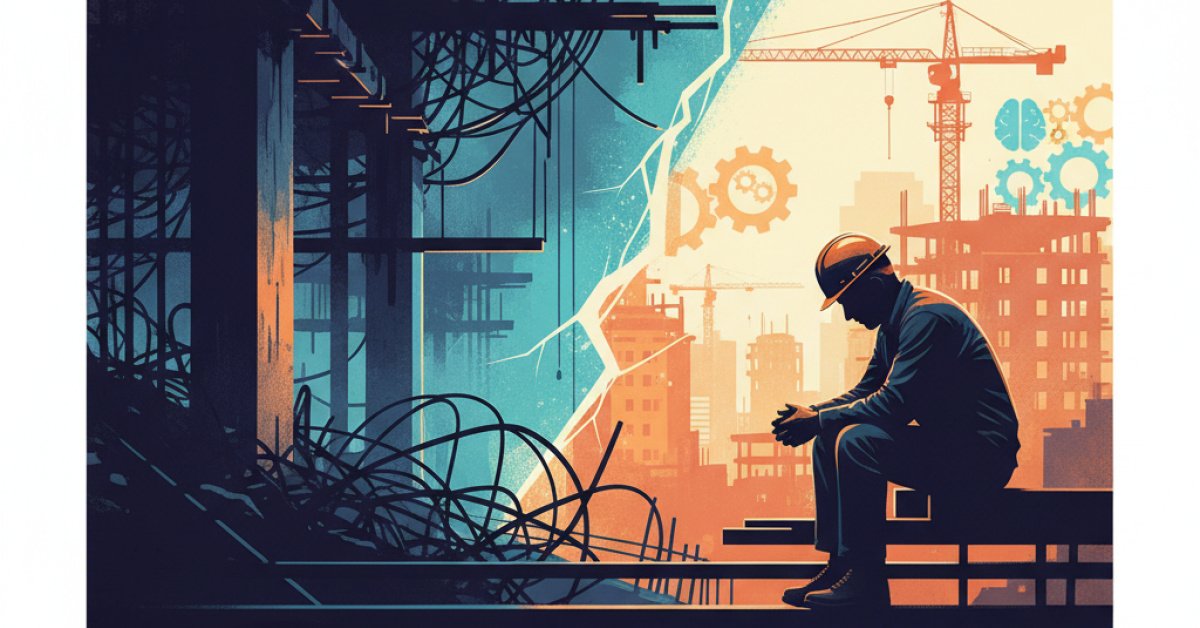
When you picture a construction worker, what comes to mind? Probably someone tough, resilient, and physically strong. We see them operating heavy machinery, scaling scaffolding, and building the world around us. We’ve spent decades, rightfully so, focusing on their physical safety—hard hats, steel-toed boots, high-vis vests.
But what about the safety under the hard hat?
A brand-new report just dropped, and honestly, the findings are a gut punch. Clayco, a major real estate and construction firm, just released its second annual mental health survey, and the numbers are more than a little concerning. They paint a picture of an industry in the middle of a silent, deepening crisis.
It turns out, the toughest job on the site might not be lifting beams or pouring concrete. It might be just getting through the day.
The Numbers Are Worse Than We Thought
Let’s get right to it. According to the survey of over 2,000 workers and execs, nearly two-thirds of construction workers—a staggering 64%—said they experienced anxiety or depression in the past year.
Think about that for a second. That’s a huge jump from 54% just one year ago. This isn't a slow burn; it's an accelerating problem.
And this isn't isolated to one group. It's hitting everyone:
- Women in the industry are feeling it most, with 73% reporting challenges.
- Gen Z workers aren't far behind at 69%.
- Even Baby Boomers, a generation often stereotyped as stoic, are struggling, with 66% reporting issues.
Anthony Johnson, the CEO of Clayco, put it perfectly: “For an industry that has made huge strides in improving and promoting the physical safety of our workers, it is time that we focus, collectively, on addressing the mental health and psychological safety issues.”
He’s right. We’ve mastered the art of preventing falls from heights, but we’re just beginning to understand how to prevent people from falling into despair.
A Double-Edged Sword: Reaching for Help, and Reaching for a Crutch
Now, here’s where the story gets complicated. There’s some good news buried in the data. More workers are actively seeking help, which is a huge step in the right direction.
The use of professional mental health services shot up to 44% from 34% the year before. And prescribed medication use also rose from 27% to 35%. This tells us that people want to get better. They’re reaching out.
But there’s a darker side to how people are coping.
A heartbreaking 58% of workers admitted to misusing substances to deal with their mental health. That’s an 11-point increase from the last survey. It’s a sign of desperation—when the formal channels feel out of reach or unsafe, people turn to whatever they can find to quiet the noise.
The primary drivers of all this stress aren't a surprise if you know the industry: the intense physical demands, a non-existent work-life balance, and the constant pressure of tight project deadlines. It’s a pressure cooker, and it’s forcing people to miss work—36% said they’ve stayed home because of their mental health.
The Real Barrier: "Tough Guy" Culture and Outright Discrimination
So, if people are struggling and many are trying to get help, what’s the real problem? It’s the culture.
Despite a willingness to support a colleague in need, a wall of silence surrounds personal struggles. The survey found that nearly half of all workers feel ashamed to talk about their mental health with coworkers. That number is actually six points higher than last year. We’re going backward.
But this next part is what’s truly infuriating. It’s not just a feeling of shame. It’s a legitimate fear of professional backlash.
Of the workers who were brave enough to seek professional help, a shocking 37% reported experiencing discrimination at work because of it.
Let that sink in. People are being punished for trying to get better.
And it’s not just a perception. The survey of executives reveals a systemic, top-down problem.
- One in five construction executives admitted that a worker who showed interest in mental health services would be given fewer important tasks.
- Almost a third (30%) said that worker would face increased monitoring on the job.
It’s a classic catch-22. The job is causing immense stress, but admitting you need help to cope with that stress could damage your career.
A Chilling Disconnect Between the Office and the Field
This whole situation is fueled by a massive disconnect between what leadership thinks is happening and what workers are actually experiencing.
A whopping 80% of executives believe their workers have good access to mental health support. But when you ask the workers themselves? Only 61% agree. That gap in perception is where problems fester.
Darcy Gruttadaro from the National Alliance on Mental Illness (NAMI) hit the nail on the head. She pointed to the "male-dominated and stoic culture that discourages many from discussing mental health," which makes workers in this field uniquely vulnerable.
It’s this culture that Dan Lester, a VP at Clayco, is working to change. “The data makes clear that stigma continues to be a barrier,” he said. His goal is to make sure everyone, from the apprentice to the CEO, understands that asking for support is a sign of strength, not a weakness.
It’s a long road ahead. We’re talking about changing the heart of an industry. But reports like this are the first step—they drag the problem out of the shadows and into the light. The next step is for every single company to look in the mirror and ask if they’re part of the problem, or part of the solution. Because right now, the silence on the job site is deafening.