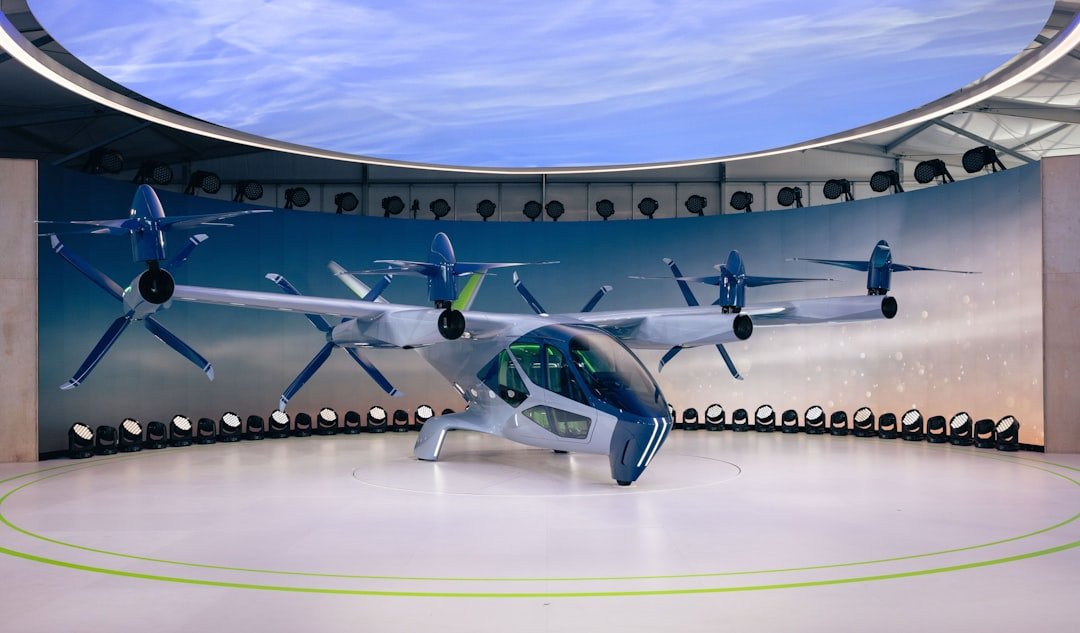
I saw the news the other day and had to do a double-take. Officials down in Kissimmee, Florida, just unveiled a brand-new piece of infrastructure for… flying cars. Seriously. They’re calling it an air taxi service, and the plan is to zip people from the Orlando area to Tampa in a fraction of the time it takes to sit in traffic on I-4.
My friends were all texting things like, “Finally! The Jetsons are here!” And a part of me gets it. It’s incredibly cool. It’s the future we were all promised in cartoons.
But my insurance brain immediately went somewhere else. My very first, gut-level thought wasn’t about how fast it would be. It was, “Oh my gosh, how on earth do you write an insurance policy for that?”
Because let’s be honest, we’re not talking about a fender bender here. We’re talking about a whole new world of risk, and it’s happening right over our heads. So, while the tech gurus are figuring out battery life and aerodynamics, let’s you and I talk about the stuff that will actually make or break this industry: the insurance.
First Off, What Exactly Are We Talking About?
Before we get into the nitty-gritty of risk, let’s get a clear picture. This isn’t just some billionaire’s new toy. A company is building a network of what they call “vertiports”—think of them like mini airports or helipads for these electric, vertical-takeoff-and-landing (eVTOL) aircraft.
The first one is up in Kissimmee. The idea is to create a transportation web, starting with that busy Orlando-to-Tampa corridor.
It’s real, it’s funded, and it’s moving forward. This isn't a "maybe someday" thing anymore. It's a "how do we prepare for this now" thing. And for those of us in the insurance world, that question is a big one.
The Billion-Dollar Question: Who's on the Hook When Something Goes Wrong?
This is where my mind immediately goes. Imagine one of these air taxis has a problem. The potential for disaster is, well, astronomical. It’s not like a car pulling over to the shoulder.
Think about the layers of liability here. It’s a giant, complex onion of risk.
If it crashes into a building…
You’ve got massive property damage. We’re talking about commercial general liability and property policies for the building owner, but the air taxi’s operator would be facing a claim that could easily run into the tens of millions.
If it hits another aircraft…
Now you’re in the world of aviation insurance, which is already a high-stakes game. But these aren’t flying in the same lanes as a 747. They’ll be in lower, more crowded airspace. The potential for mid-air collisions with drones, helicopters, or even other air taxis is a terrifying new variable.
If passengers are injured or killed…
This is the most tragic and, from an insurance standpoint, the most expensive risk. Passenger liability would have to be enormous. We’re talking about coverage that makes high-end car insurance look like pocket change.
If people on the ground are hurt…
This is the one that keeps me up at night. A malfunction over a crowded theme park, a busy highway, or a suburban neighborhood could be catastrophic. The third-party liability claims would be staggering.
It's a completely different risk profile than anything we've dealt with on a mass scale. A car accident is usually contained to a few vehicles. An air taxi accident could involve a vehicle worth millions, a commercial property, and dozens of lives all at once.
This Isn't Just "Aviation Insurance, But Smaller"
Some people might say, "We already insure helicopters and small planes. What's the big deal?"
That’s a huge oversimplification. This is a fundamentally different beast for a few key reasons.
The Autonomy Problem
Here’s the real kicker: many of these vehicles are designed to be partially or fully autonomous. So, if an AI pilot makes a mistake, who’s at fault?
- Is it the operator who runs the service?
- Is it the manufacturer of the aircraft?
- Is it the company that wrote the software that flies the thing?
- Is it the maker of the sensor that failed to see an obstacle?
This blurs the line between traditional liability and product liability in a way we've never seen before. A claims adjuster would have a nightmare trying to figure out who to file against. And you can bet the lawyers will have a field day.
The Sheer Scale of It All
We insure private jets, sure. But there aren't thousands of them flying over downtown Orlando every day. The vision for this is an on-demand service, like an Uber for the sky.
That frequency dramatically changes the exposure. More flights mean more takeoffs and landings—the most dangerous parts of any flight. It also means more chances for software glitches, battery failures, and human error. Underwriters have to price the risk for a whole fleet operating constantly, not just one plane flying a few times a week.
The Cyber Risk is Terrifying
Let’s go full Hollywood for a second, because this is a real risk. What if a hacker gets into the central command system? They could potentially ground the entire fleet, or worse, send them flying into each other or into buildings.
A standard aviation policy doesn't cover that. You'd need a highly specialized, incredibly robust cyber insurance policy. And even then, how do you quantify the risk of something that's never happened before?
So, What Would an Air Taxi Insurance Policy Even Look Like?
Honestly, no one has a perfect answer yet. The first policies for these services are going to be custom jobs—Frankenstein's monsters stitched together from different types of coverage.
I imagine it would have to include pieces of:
- Aviation Hull & Liability: The core coverage for the aircraft itself and for causing injury or damage. This would be the foundation.
- Product Liability: A massive policy to cover the manufacturer for any defects in the hardware or software.
- Cyber Insurance: A non-negotiable policy to protect against hacking and data breaches.
- Infrastructure Insurance: Coverage for the vertiports, charging stations, and maintenance facilities on the ground.
- Business Interruption: What happens if the FAA grounds the whole fleet for a month because of a safety concern? This coverage would help the operator survive the loss of income.
The first company to get a comprehensive policy is going to pay a fortune for it. Insurers are stepping into the unknown, and they're going to price that uncertainty into the premiums.
It’s a classic chicken-and-egg problem. You can't fly without insurance, but you can't get insurance without historical data on safety and risk—which doesn't exist yet. The first insurers to step into this market are taking a huge gamble, but if they get it right, they could define the industry for decades.
So, while it’s exciting to see the future of transportation unfolding in Florida, it’s also a pivotal moment for the insurance industry. We’re the ones who have to build the financial safety net that makes all of this innovation possible.
It’s going to be complex, it’s going to be expensive, and it’s going to be fascinating to watch. The next time you see a headline about flying cars, just remember the invisible, incredibly complicated web of insurance that’s working behind the scenes to keep that future from coming crashing down.