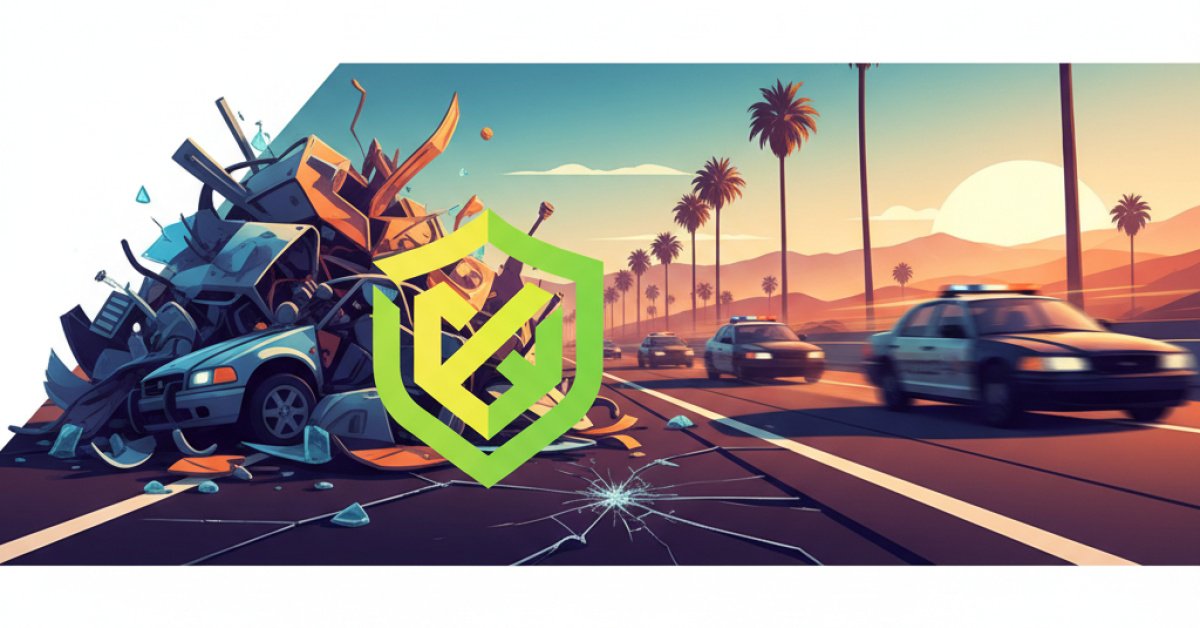
You probably saw the news story. It sounded like something straight out of a movie. A suspect in a stolen minivan leads the police on a wild, two-hour chase stretching 170 miles across four different counties in Southern California. We all watch these things on TV, glued to the screen, maybe shaking our heads at the absurdity of it all.
But as someone who lives and breathes insurance, I watch those chases and see something else entirely: a massive, tangled web of financial chaos. For every swerve, every near-miss, and every piece of property damaged, there's an insurance question waiting to be answered. The driver eventually ditched the van and slipped across the border into Mexico, leaving a trail of destruction behind.
So, who cleans up the mess? Who pays for the crumpled fenders, the broken signs, and the stolen minivan itself? Let’s pull back the curtain on this Hollywood-style chase and talk about what it really means for your insurance policy.
The First Victim: What About the Stolen Minivan?
Let's start with the person whose day was probably ruined first: the owner of the minivan. They walk outside, keys in hand, and their car is just… gone. It's a horrible feeling. A few hours later, they see it on the news, getting driven into the ground by a stranger.
This is where a specific part of your auto policy, Comprehensive Coverage, steps in.
A lot of people think "full coverage" is one single thing, but it's really a bundle of different coverages. Collision covers you when you hit something (another car, a pole, etc.). Comprehensive is for almost everything else. Think of it as the "life happens" coverage.
It typically covers things like:
- Theft
- Vandalism
- Fire
- Falling objects (like a tree branch)
- Hitting an animal
In this case, the minivan was stolen, which is the classic textbook definition of a comprehensive claim. The owner would file a police report, then a claim with their insurance company. The insurer would likely declare the vehicle a total loss, especially after a 170-mile high-speed pursuit, and pay the owner its actual cash value (minus their deductible).
What If You're an Innocent Bystander?
Okay, now let's shift gears. Imagine you’re just driving to the grocery store, and this whole circus comes barreling through an intersection. The stolen van sideswipes your car and keeps on going.
Your first thought is probably, "Well, their insurance will pay for it!"
Here's the problem. The driver is a criminal who stole the car. The chances they have a valid insurance policy are pretty much zero. And even if they did, good luck finding them now that they’ve fled the country. So, you're left with a damaged car and an at-fault driver who has vanished.
This is where your own insurance policy becomes your absolute best friend. You have two main options here.
Option 1: Your Collision Coverage
If you have collision coverage, you can use it to fix your car. You’ll file a claim, pay your deductible (say, $500 or $1,000), and your insurance company will handle the rest.
Normally, your insurer would then go after the at-fault driver's insurance to get their money back (and your deductible, too!). This process is called subrogation. But in a case like this? There's no one to go after. The trail is cold. So, you'll get your car fixed, but you're probably not getting that deductible back. It’s not ideal, but it’s way better than paying for the entire repair yourself.
Option 2: The Unsung Hero, Uninsured Motorist Coverage
This is the coverage that was practically designed for situations like this. Uninsured/Underinsured Motorist (UM/UIM) Coverage protects you when you're hit by someone who either has no insurance or not enough insurance.
In many states, this coverage can apply to your car's damage (it's called Uninsured Motorist Property Damage or UMPD) and, more importantly, to any injuries you or your passengers sustain (Uninsured Motorist Bodily Injury or UMBI).
If you have UMPD, you could use it to repair your car. The best part? The deductible is often much lower than your collision deductible—sometimes as low as $100 or $250. It’s a lifesaver in a hit-and-run or a scenario with a phantom driver like this one.
Why the "Escaped to Mexico" Part Is a Huge Deal
The fact that the suspect fled across the border is more than just a dramatic ending to the story; it’s a giant red flag for the insurance companies involved.
As I mentioned, subrogation is the process of an insurance company recovering money from the party that caused the loss. It's how the system keeps costs down and holds the right people accountable.
But when the at-fault party crosses an international border, that process grinds to a halt. Trying to pursue a claim against an individual in another country, especially one who is already a fugitive, is a legal and logistical nightmare. It's incredibly expensive and rarely successful.
This detail hammers home the most important lesson of all: You cannot depend on the other driver to make you whole. You just can't.
The Real Takeaway from This Crazy Chase
It’s easy to watch a story like this and think of it as just another wild day in Southern California. But the truth is, smaller versions of this happen every single day in every city. People get hit by uninsured drivers. Hit-and-runs happen in parking lots.
You can’t prevent someone from making a reckless decision, but you can make sure your financial safety net is strong enough to catch you. This story is the perfect, if extreme, example of why just having the state-minimum liability insurance isn't enough.
So, what can you do? Pull out your own insurance policy (or log into your online portal) and look for two things:
- Collision Coverage: Do you have it? Is the deductible an amount you could comfortably pay tomorrow if you had to?
- Uninsured/Underinsured Motorist Coverage (UM/UIM): Do you have this? And what are the limits? This is often one of the most affordable coverages you can buy, and as we've seen, it can be one of the most valuable.
At the end of the day, good insurance isn't about planning for a normal Tuesday. It's about planning for the chaotic, unpredictable, 170-mile-police-chase kind of day. It’s about having peace of mind, knowing that even if the world goes a little crazy, you’re protected.