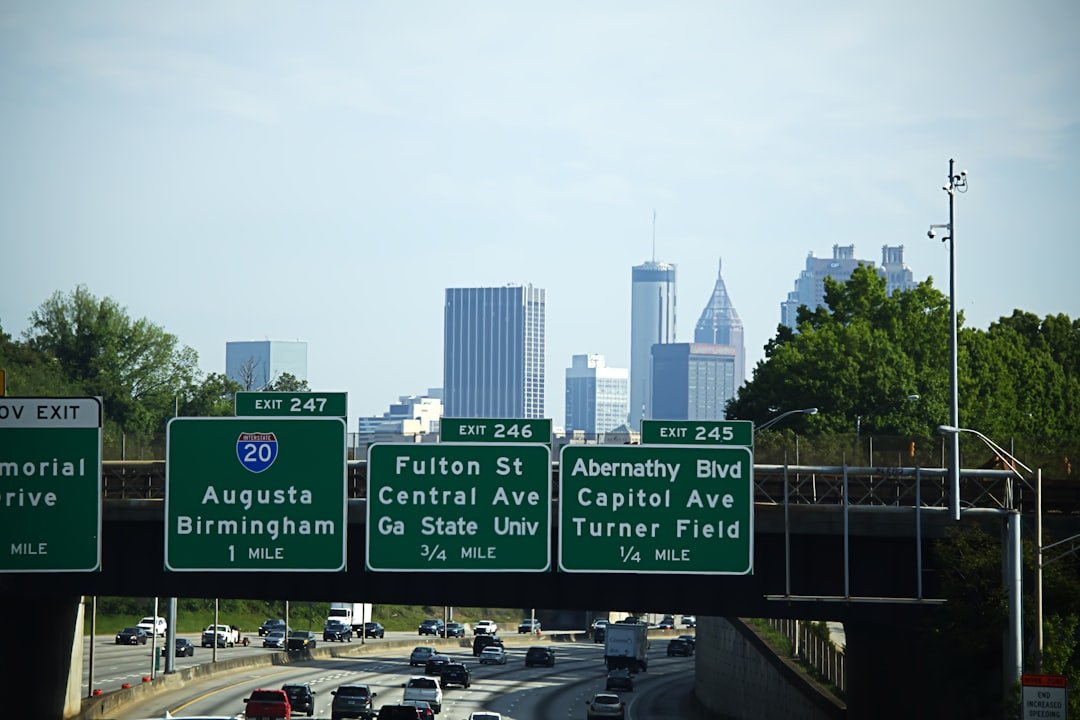
If you’ve ever driven through Atlanta, you know the feeling. That slow, creeping dread as the brake lights in front of you multiply and your GPS adds another 45 minutes to your trip. And if you’ve ever been on Interstate 75, especially where it tangles up with I-285, you’ve been in one of the country’s most notorious parking lots.
It’s the kind of traffic that makes you grip the steering wheel a little tighter, watch the cars around you a little closer, and maybe say a little prayer that you don't become part of a five-car fender-bender.
So, when I heard that Georgia’s Governor, Brian Kemp, announced a massive $1.8 billion plan to try and fix this mess, my first thought wasn't just, "Finally!" As an insurance person, my mind immediately went somewhere else. You might be thinking, "What on earth does a road construction project have to do with my insurance policy?" The answer is: a whole lot more than you’d think. Let’s break it down.
That Infamous I-75 Chokepoint
First, let's talk about the project itself. We're looking at a $1.8 billion investment aimed squarely at one of the biggest bottlenecks in the Southeast. I-75 isn't just a local highway; it's the main artery connecting the Midwest all the way down to Florida. Think about all the vacationers, all the snowbirds, and, most importantly, all the semi-trucks carrying goods up and down the coast.
They all have to squeeze through Atlanta.
Governor Kemp’s plan is ambitious. It's designed to unclog this critical point, making the flow of traffic smoother and, hopefully, much safer. But building new lanes and redesigning interchanges is about more than just concrete and asphalt. It's about changing the risk equation for every single vehicle that travels that road.
The Surprising Connection Between Traffic and Your Premiums
Okay, so how does this actually connect to the world of insurance? It’s not just one thing; it’s a ripple effect that touches several different areas.
Fewer Fender-Benders Means Fewer Claims
Think of a congested highway like a crowded hallway between classes. When everyone is packed in, shoulder-to-shoulder, and trying to move, people are going to bump into each other. It's almost inevitable. The same thing happens on the road.
Stop-and-go traffic is a recipe for rear-end collisions, sideswipes, and chain-reaction accidents. These are the most common types of auto insurance claims. They might not always be severe, but they happen constantly, and they add up.
- Less Congestion = Less Risk: When traffic flows more freely, drivers have more space between vehicles and more time to react. This fundamentally reduces the frequency of accidents.
- The Impact on Insurers: For auto insurers, a reduction in claim frequency in a high-traffic area like Atlanta is a very big deal. Fewer claims mean less money paid out, which can lead to more stable rates for everyone in the long run.
Now, let's be realistic. Your personal auto premium probably isn't going to drop the day they cut the ribbon on this project. But over time, if the project successfully reduces accident rates, it will absolutely have a positive influence on the data that insurers use to set their prices for the entire region.
A Game-Changer for Commercial Trucking
While this is good news for commuters, it's a potential godsend for the trucking industry. For a commercial truck, time is literally money. Every hour spent idling in traffic is an hour of lost revenue, wasted fuel, and increased risk.
Imagine you're insuring a fleet of 50 semi-trucks that have to run the I-75 gauntlet every single day. The risk of accidents, cargo damage, and delivery delays is baked into their insurance premiums. It’s a huge operational headache and a major cost.
A project that shaves significant time off that route and reduces the chance of a crash is music to a commercial insurer's ears. It lowers the risk profile of their clients, which can translate into more favorable premiums and better coverage options for those trucking companies. It makes the entire supply chain more efficient and less risky, and that’s a win for everyone.
The Invisible Giant: Surety Bonds
Here’s the part of the story you won’t see on the evening news, but it’s a massive piece of the insurance puzzle. A $1.8 billion construction project doesn't just happen with a handshake.
The state of Georgia needs a guarantee that the construction companies hired will actually finish the job on time and on budget. That guarantee comes in the form of something called a surety bond.
Think of it like this: a surety bond is a three-party agreement between the state (the project owner), the construction company (the principal), and an insurance company (the surety). The insurance company is essentially promising the state, "If this construction company fails to complete the project, we will step in and make sure it gets done."
Securing a surety bond for a project of this magnitude is a monumental undertaking. Insurers have to do an incredibly deep dive into the contractor's finances, experience, and capabilities. It’s one of the biggest and most complex parts of the commercial insurance world, and a $1.8 billion project like this represents a huge piece of business for the insurers who underwrite these bonds.
So, What Does This Mean for You?
It’s easy to look at a giant infrastructure project and just see traffic cones and delays for the next few years. And let’s be honest, we’re definitely in for some of that.
But looking beyond the construction dust, this is a powerful example of how our physical world is directly tied to the financial world of risk and insurance. By investing in smoother, safer roads, Georgia isn't just improving our daily commutes; it's actively working to reduce risk.
And reducing risk is the name of the game in our industry. It might take a while to see the full effects, but a project like this has the potential to make our roads safer, our supply chains stronger, and, just maybe, our insurance market a little bit healthier. It’s something I’ll definitely be watching closely, both as a driver and as someone who geeks out about this stuff for a living.