Have you heard the news? The Bank of Canada recently came out with a surprisingly sunny take on artificial intelligence. They basically said that as AI becomes more common, it’s going to give our country’s sluggish productivity a much-needed shot in the arm.
And here’s the kicker: they don’t think it’s going to lead to massive, scary job losses.
Now, if you’re like me and you work in insurance, you might hear that and think, “Okay, that’s nice for the big-picture economy, but what does that have to do with my desk, my clients, and my career?”
That’s a fair question. Because let’s be honest, we’ve all seen the headlines. We’ve heard the whispers about AI “disrupting” our industry. Is it here to replace underwriters? To make brokers obsolete? It’s easy to feel a little anxious. But what the Bank of Canada is suggesting is a different story, and I think it’s one we need to pay close attention to.
So, What Exactly Did the Bank Say?
In her very first speech as an external deputy governor, a top official at the Bank of Canada laid out a pretty optimistic vision. The core message was that the widespread adoption of AI technologies could be the key to fixing Canada’s productivity problem—something economists have been worried about for a while.
Think of it like this: for years, our economic engine has been running a bit rough. The Bank of Canada is looking at AI as a potential high-octane fuel that can make the whole thing run smoother and faster.
The most interesting part for us, though, is their take on the human element. They pushed back against the dystopian idea of robots taking over everyone's jobs. Instead, they see a future where AI works alongside us, making us better and more efficient at what we do. It’s a subtle but really important distinction.
Let's Bring This Down to Our World: AI in Insurance
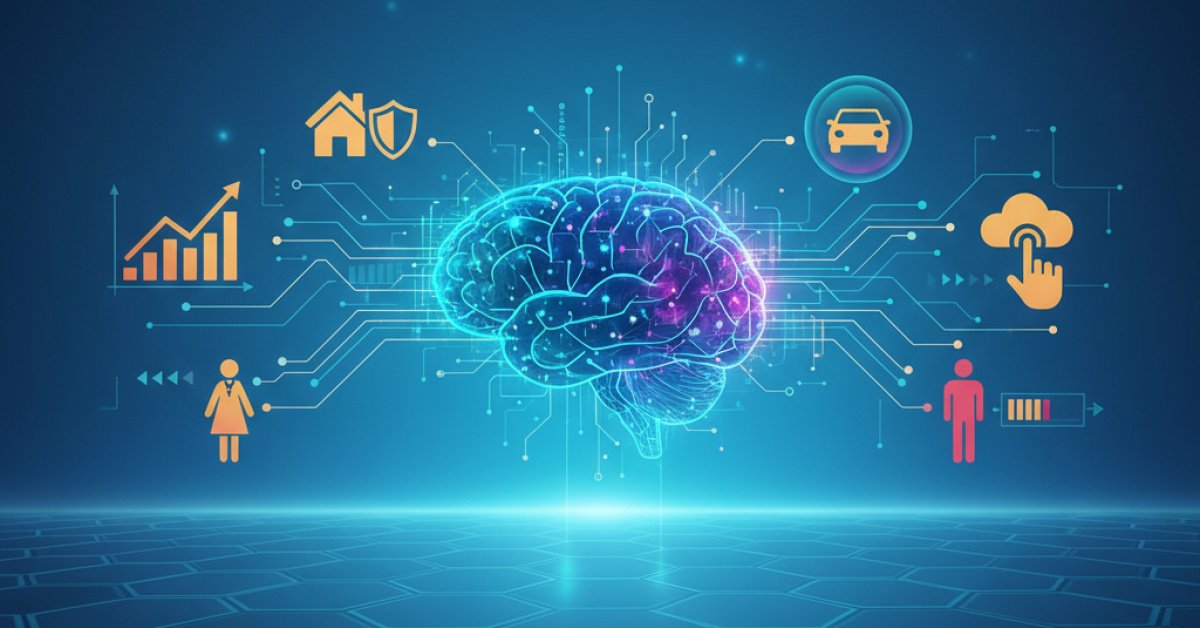
Alright, enough with the high-level economics. How does this "productivity boost" actually show up in a brokerage, an MGA, or a carrier's head office? It’s not as sci-fi as you might think. In fact, it’s already happening.
Underwriting Gets a Super-Powered Assistant
Imagine an underwriter who can analyze a complex commercial risk in a fraction of the time it takes today. Instead of manually sifting through hundreds of pages of documents, an AI tool could instantly flag key risks, highlight missing information, and even pull up relevant historical data for similar policies.
This doesn't replace the underwriter's judgment. Not at all. It just clears away the tedious, time-consuming stuff, freeing them up to focus on the truly complex parts of the puzzle—the strategic thinking and relationship-building that a machine can’t do. The Bank of Canada’s vision suggests more of this: AI as a co-pilot, not the pilot.
Claims Processing That’s Faster and Smarter
We all know that a fast, fair claims process is where the rubber really meets the road for our customers. It’s the moment of truth. AI is already making a huge impact here.
Think about:
- Initial Triage: AI can instantly sort incoming claims, flagging the urgent ones and routing simple ones for automated approval.
- Damage Assessment: A policyholder can upload photos of a dented car bumper, and an AI model can provide an initial damage estimate in seconds.
- Fraud Detection: Sophisticated algorithms can spot patterns in claims data that are invisible to the human eye, helping us catch fraud early and keep costs down for everyone.
This isn't about removing the empathetic, human touch from a difficult claims experience. It's about getting the ball rolling faster so our claims professionals can spend their time helping people, not filling out paperwork.
But What About Our Jobs?
This is the big question, isn't it? If AI can do all this, what’s left for us?
The Bank of Canada’s perspective is reassuring. They believe AI will be a tool that augments human workers, not one that replaces them wholesale. The nature of our jobs will change, for sure. Some of the repetitive, data-entry tasks will fade away. But the need for expertise, critical thinking, and genuine human connection will only become more valuable.
A broker’s value isn’t just finding the cheapest quote; it’s in understanding a client’s unique life situation and providing wise counsel. An adjuster’s role isn’t just to process a payment; it’s to guide someone through a stressful and emotional time.
I genuinely believe that AI will free us up to be more human in our roles, not less. It handles the "what" so we can focus on the "why" and "how."
It's Not a Magic Bullet, Though
Of course, this is not going to be a simple, flip-a-switch transition. The Bank of Canada is optimistic, but we have to be realistic. There are real hurdles to clear.
For one, implementing this technology costs money and requires a huge amount of technical skill. Smaller brokerages and firms might struggle to keep up with the big players.
And then there's the whole can of worms that is data privacy and ethics. We handle incredibly sensitive information about our clients. We have a massive responsibility to use these powerful new tools ethically and ensure that the data is secure and the algorithms are fair and unbiased. Regulators are watching this space closely, and so are we.
The bottom line is that the path forward requires careful planning and a commitment to retraining and upskilling our teams. We can’t just buy some software and hope for the best. We need to invest in our people, helping them adapt to a new way of working where technology is a partner.
So, when you see a headline about the Bank of Canada and AI, don’t just scroll past it. It's more than just economic theory. It’s a signal about the future of work in Canada, and the insurance industry is right at the heart of it. The message isn't one of fear, but of opportunity. It's a chance to build a smarter, faster, and more human-centric industry. And honestly, that’s a future I’m excited to be a part of.